

How to Choose the Right Yoga Mat for Small Spaces

Last Updated: November 16, 2026
Quick Summary
To choose the right yoga mat for small spaces, measure your clear floor area and storage gaps first, then compare those numbers against the mat's length, width and packed dimensions. A typical yoga mat is about 173 cm long and 61 cm wide, so a foldable mat suits under-bed gaps while a rolled mat needs cupboard or corner space.
- Add roughly 15-20 cm to your height for lying poses and leave a hand's width on each side.
- A 4-6 mm mat suits most people, while mats above 8 mm make standing balances wobblier.
- A standard mat at 4-6 mm rolls to a cylinder roughly 60-65 cm long and 13-15 cm in diameter.
- A foldable mat typically folds into a stack about 30-35 cm wide, 60-65 cm long and 8-12 cm deep.
- Choose a mat you can set up and pack away in under a minute without moving furniture.
Table of Contents
- Measure Your Floor Space Before You Choose a Yoga Mat
- Yoga Mat Dimensions That Actually Fit a Small Room
- Yoga Mat Thickness: Cushioning Versus Stability
- Foldable Yoga Mat or Rolled Mat: Which Stores Better?
- Grip, Texture and Material for Compact Practice Areas
- How to Store a Yoga Mat in a Flat or Shared Room
- Match the Mat to Your Practice Style and Budget
- Pick Your Mat and Check It Against Your Measurements
- Frequently Asked Questions
Measure Your Floor Space Before You Choose a Yoga Mat
Most buying guides start with thickness charts. That's backwards. If you live in a flat where the coffee table has to move before you can stretch out, the room sets the rules, not the mat. Learning how to choose the right yoga mat for small spaces starts with a tape measure, not a product page. Home fitness gear is often returned because it doesn't fit the room, so we'll show you how to measure first and shop second.
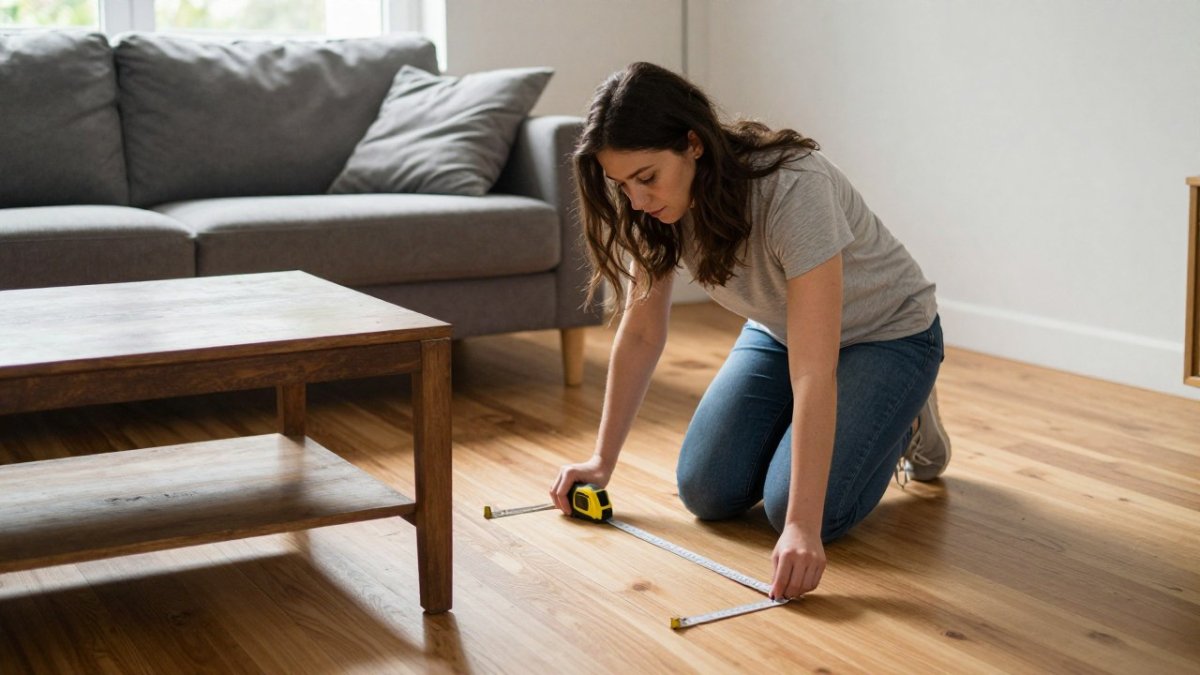
Work Out Your Clear Floor Area
Clear floor area is the usable rectangle left once furniture, door swings and walkways are excluded. Measure the longest and widest points at floor level, then subtract anything that blocks a full stretch. A spare bedroom often yields more clear space than a living room, even when the living room looks bigger.
Allow for Reach and Roll-Out Room
Your mat only needs to fit your body at full extension, plus a little margin. Add roughly 15-20 cm to your height for lying poses, and leave a hand's width on each side so your arms don't hit skirting boards.
If your practice area is genuinely tight, our guide to space saving home gym setup tips for small flats covers ways to reclaim floor without rearranging the whole room.
Yoga Mat Dimensions That Actually Fit a Small Room
Standard mats are longer than most people expect. A typical yoga mat runs about 173 cm long and 61 cm wide, while thicker comfort mats and Pilates mats often stretch to 183 cm or more.
Measure your clear rectangle, then compare it against three figures: mat length, mat width and mat thickness. A shorter travel mat may suit a box room; a full-length mat suits a spare bedroom. Width matters more than people think, because narrow mats force your hands onto the floor during wide poses.
| Mat Type | Typical Length | Typical Width | Typical Thickness | Storage Style |
|---|---|---|---|---|
| Standard yoga mat | 173 cm | 61 cm | 4-6 mm | Rolled |
| Long comfort mat | 183 cm | 61-66 cm | 6-8 mm | Rolled |
| Travel mat | 173 cm | 61 cm | 1-3 mm | Rolled or folded |
| Foldable mat | 173-183 cm | 61 cm | 4-6 mm | Folded flat |
| Pilates mat | 183 cm | 61 cm | 8-15 mm | Rolled |
Typical Thickness
Yoga Mat Thickness: Cushioning Versus Stability
Thicker mats cushion joints but make balance harder. A 4-6 mm mat suits most people: enough padding for knees and wrists, still firm enough to feel the floor.
Beginners often assume more padding means more comfort. In practice, a very thick mat can strain ankles and knees during standing poses. If you have sensitive joints, a mid-range thickness with a denser material gives better support than a soft, deep cushion.
Foldable Yoga Mat or Rolled Mat: Which Stores Better?
Foldable mats win in rooms with no wall space, because they fold into a flat rectangle that slides under a bed or behind a door.
Here's the trade-off most guides skip: folding creases the mat over time, and those creases can become weak points in the surface. Rolling avoids creases but takes up a footprint. For a shared room, a foldable mat that tucks away flat usually beats a rolled mat leaning against the skirting board.
Packed Dimensions to Compare Before You Buy
Most listings quote the open mat size but bury the packed size, which is the number that decides whether a mat fits your flat.
Those figures matter because storage gaps are small. A typical under-bed clearance of 12-15 cm will take a folded mat but not a rolled one standing on its edge; a cupboard shelf 35 cm deep will take a rolled mat lying down but not a folded mat left flat.
Setup Time and Daily Friction
A rolled mat takes a few seconds to unroll and a few more to flatten if it has been stored tightly; a foldable mat unfolds in one movement but may need a moment for the creases to settle before standing poses feel stable. In a multi-use room where the mat goes down and up twice a day, that difference adds up.
How Creasing Affects Grip and Lifespan
Folding concentrates stress along the same lines every time. On foam and PVC mats those lines soften first, and the surface can crack or lose texture at the fold, which is exactly where hands and feet land in downward-facing poses. Rubber mats tolerate folding better because the material recovers, but repeated folding still leaves ridges that interfere with grip. Rolling spreads the bend across the whole mat, so it wears more evenly, the cost is the storage footprint, not the surface.
Durability and Material Fit
Material affects how a mat handles rolling and folding, so check the construction details on the product page before you buy.
- Foldable mat: best for under-bed storage, shared rooms and quick setup; check the folded depth against your gap and expect some creasing over time
- Rolled mat: best for cupboards, corners and longer-term durability; check the rolled diameter against shelf height and secure it so it doesn't unroll
- Travel mat: best for multi-use rooms where the mat doubles as a gym or picnic mat; thin enough to fold, but too little cushioning for daily floor work on hard floors
Watch out: a folded mat stored under a bed can pick up dust and pressure marks from the bed frame, so air it and rotate the fold lines between uses.
Grip, Texture and Material for Compact Practice Areas
Grip matters more in small spaces, not less. When your mat sits on a hard floor with furniture close by, a slip can mean a knock against a table leg.
Material choice drives both grip and durability. Natural rubber offers strong traction and a firm feel but is heavier. PVC and EVA foam are lighter but wear faster and can feel slick when your hands get damp.
How to Store a Yoga Mat in a Flat or Shared Room
Storage is where small-space buyers get caught out. A rolled mat left on the floor becomes an obstacle; a folded mat left on a chair gets sat on. The fix is to decide the storage spot before you buy, then match the mat to it.
Measure the Three Storage Gaps That Matter
Before comparing mats, measure three gaps in your flat and write the numbers down:
- Under-bed clearance: the height from floor to the underside of the bed frame, measured at the lowest point. Most flats give 12-18 cm; a folded 6 mm mat typically needs 8-12 cm, a rolled mat standing upright needs 13-18 cm of diameter.
- Cupboard shelf depth and height: the usable depth front-to-back and the clear height between shelves. A rolled mat lying on its side needs roughly 15-18 cm of height and 60-65 cm of length; a folded mat needs 30-35 cm of width and 8-12 cm of depth.
- Door-frame and behind-door width: the clear width between the door and the wall when open. A folded mat lent behind a door needs about 10 cm of clearance and a hook or strap to stop it sliding.
If none of those gaps works, the mat has to live vertically: a rolled mat in a tall cupboard, a corner stand, or a wall hook. Measure the height of the cupboard or the wall space before assuming a rolled mat will stand there.
Match the Storage Style to the Room
A room used for living most of the day rewards a mat that disappears completely, under a bed, behind a sofa or in a lidded storage bench. A room with a dedicated corner can take a rolled mat on a stand, which is quicker to grab and put back. Shared rooms usually suit a foldable mat plus a strap or a shallow storage box that also holds a block and strap, so setup is one movement rather than three.
Keep the Mat Dry and Odour-Free
Watch out: storing a damp mat folded or rolled traps moisture and causes odour and surface damage. Air it flat first, ideally over a chair back or a drying rack, until the surface feels dry to the touch, then store it. In a flat with limited airing space, a quick wipe with a damp cloth and a dilute mild soap followed by a full air-dry is better than storing it damp and hoping.
Quick Setup and Pack-Away in a Multi-Use Room
The storage spot should let you set up and pack away in under a minute without moving furniture. Practise the routine once: unroll or unfold, check the mat sits flat, use it, air it briefly, then return it to its spot.
For more ideas on fitting a practice zone into a shared room, see our guide to setting up a home workout space and our broader tips on organizing small apartment spaces.
Match the Mat to Your Practice Style and Budget
Your practice style narrows the choice fast. Slow, floor-based movement like yin or restorative yoga rewards a thicker, softer mat. Faster flows and standing balances need a firmer, grippier surface.
Budget matters, but cheap mats often cost more over time because the surface wears and the grip fades. If you're weighing a mat against other gear, our roundup of the best home fitness equipment for small apartments and our checklist of essential fitness gear for beginners help you prioritise.
Best for: slow, floor-based practice in a box room, choose a foldable 6 mm mat. Skip if: you do fast flows on hard floors, a thin travel mat will slip and feel unstable.
Pick Your Mat and Check It Against Your Measurements
Before you buy, run one final check. Compare the mat's length, width and folded or rolled dimensions against the numbers you wrote down at the start. If the folded mat doesn't fit your under-bed gap, or the rolled mat won't stand in your cupboard, it's the wrong mat for your room, however good the reviews.
- Clear floor rectangle measured and written down
- Mat length fits your height plus 15-20 cm
- Mat width leaves a hand's width each side
The right mat for a small space is the one you can unroll, use and put away without a fight. For current range and prices, visit the Metanoia media website.
Frequently Asked Questions
What size yoga mat is best for a small space?
A standard mat of roughly 173 cm by 61 cm fits most compact rooms, and a shorter 152 cm travel mat works if you are under about 170 cm tall. Measure your clear floor area first, then check the mat's length and width against it with room to spare for arm reach. Wider mats of 66 cm or more give more shoulder room but take up extra floor and storage space.
Can you use a travel yoga mat for everyday practice?
Yes, with trade-offs. Travel mats are thin, often 1 to 2 mm, so they roll small and store easily, but they offer little joint support on hard floors. If you practise daily on wood or tile, put a thicker mat underneath or choose a 4 mm mat that still rolls compactly. A travel mat suits slower, floor-based sessions better than strenuous standing poses.
How thick should a yoga mat be for home use?
Most people are comfortable on a mat between 4 mm and 6 mm thick. Thinner mats give better balance and ground feel for standing poses, while thicker mats cushion knees and wrists during floor work. Anything above 8 mm starts to feel unstable in balance poses and rolls into a bulkier shape, which matters when storage space is tight.
What is the best way to store a yoga mat in a small flat?
Roll your mat loosely rather than tightly, then stand it upright in a corner, behind a door or inside a tall basket so it takes up less floor space. Foldable mats can be folded flat and slid under a bed or sofa. Clean and dry the mat fully before storing to prevent odour, and avoid leaving it rolled tight for long periods, as this can leave creases.
