

How to Organize Small Apartment Spaces: 7 Steps

Table of Contents
- How to Organize Small Apartment Spaces: A Practical 7-Step Plan
- Small Apartment Storage Solutions That Actually Work
- Space Saving Furniture for Small Flats: What to Look For
- Decluttering Tips for Small Homes: The One-In-One-Out Habit
- Set Up a Compact Home Workout Area Without Losing Floor Space
- Lighting, Ventilation and Noise: The Parts Most Guides Skip
- Common Mistakes When Organizing a Small Flat
- Conclusion
- Frequently Asked Questions
Last Updated: October 3, 2026
How to Organize Small Apartment Spaces: A Practical 7-Step Plan
Learning how to organize small apartment spaces comes down to one principle: use height, not floor area. A typical flat has more unused wall space than usable floor, and most people fill the floor first.
Below, we'll show you exactly how to plan each step, what to buy, and the mistakes that undo the work within a month.
Small Apartment Storage Solutions That Actually Work
Storage works best when it moves upward. Floor space is your scarcest resource, so treat every wall as usable square footage, but treat it as load-bearing square footage, because a shelf that pulls out of plasterboard takes the wall with it.
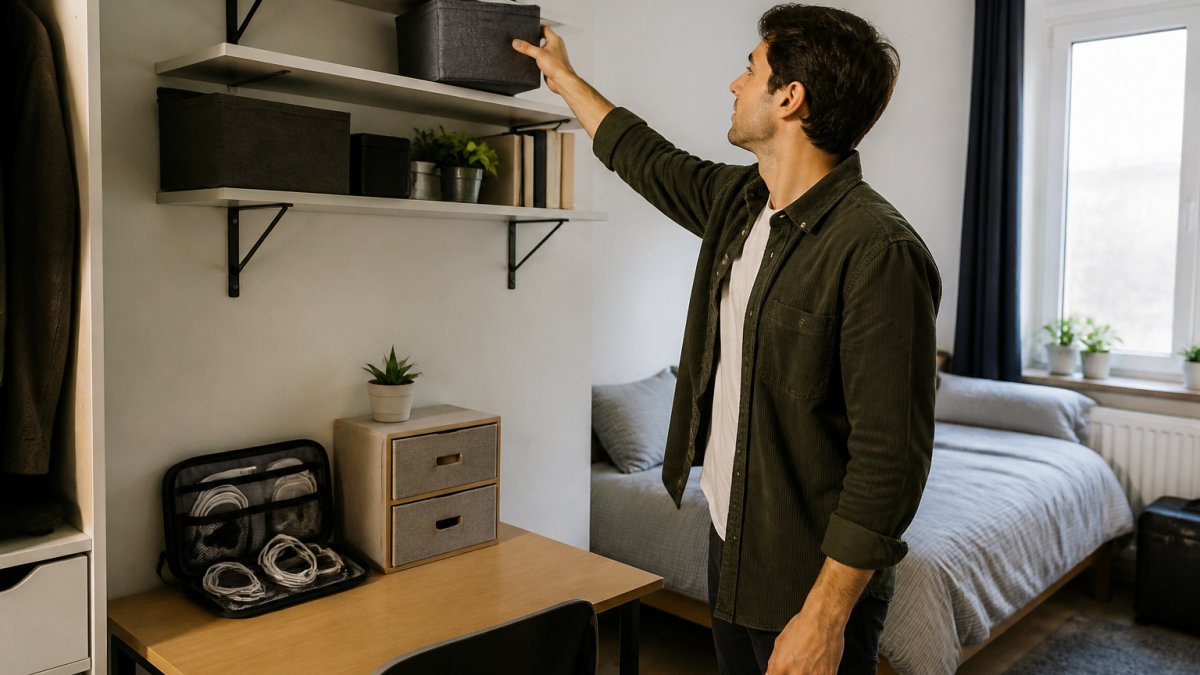
Use vertical space with the right fixings
Start by looking at your walls from floor to ceiling. Most people stop at eye level, which leaves the top third of the room empty.
- Fit shelves above door frames and windows, where nothing else can go.
- Hang hooks inside cupboard doors for cleaning tools, bags and leads.
- Stack storage boxes in a floor-to-ceiling column in a corner.
- Mount a rail above a desk for pens, cables and keys.
The fixing matters as much as the shelf. Plasterboard alone will not hold a loaded shelf. Use wall plugs rated for the load, or fix into studs and masonry where you can. A shelf holding books or tools needs a fixing rated well above the weight you intend to put on it, allow a generous margin, because the load is dynamic every time you reach for something.
Leave a ventilation gap
A common mistake is to pack storage tight against the wall from skirting to ceiling. That traps damp air behind the boxes, and in a small flat with a single window it can lead to condensation and musty fabric. Leave a gap of a few centimetres behind stacked units, and never block a vent, an air brick or the gap under a door.
Contain the small items first
Small items cause the most visual clutter. A pile of loose cables on a desk makes an otherwise tidy room look messy, and clutter on surfaces is what makes a small room read as cramped.
A double-layer organiser bag holds cables, chargers, a power bank and earphones in one place. The HAWEEL Electronic Organizer Double Layers Storage Bag measures 20 cm x 12 cm x 4 cm, so it fits in a backpack or a desk drawer without taking much room.

For keys and cards, a wall-mounted key box with a four-digit combination lock keeps them off surfaces and out of sight. Mount it at the height you actually reach for it, usually around 1.4 m, rather than wherever the wall is free.
Zone the storage, not just the room
Storage that is spread evenly around a small flat still feels like clutter, because every surface carries something. Group storage by purpose instead: one zone for work, one for sleep, one for the workout corner, one for the front door. When each zone has its own container, the eye reads order even when the room is full.
A desktop drawer unit can hold the small items that never find a home. The Desktop Drawer Storage Box has three transparent drawers at 22.8 cm x 16.6 cm x 7.7 cm, and the units stack. That makes it easy to add capacity without adding furniture, and because the drawers are clear, you can see what is in them without pulling them out.

Space Saving Furniture for Small Flats: What to Look For
Good space saving furniture for small flats does two jobs at once. A bench with storage under the seat replaces a bench and a box. A desk with shelves replaces a desk and a bookcase.
Look for these features:
- Folds flat or nests when not in use
- Doubles as storage
- Sits on legs, so you can see and clean underneath
- Matches your wall colour, so it blends in
Measure Before You Buy
Measure twice, buy once. This is where most online furniture orders go wrong.
- Measure the floor area where the item will sit
- Measure doorways and stairwells on the route in
- Add 5 cm clearance on each side for doors and drawers
- Check ceiling height if the item is tall
Write the numbers down before you shop. A tape measure costs less than a return.
Decluttering Tips for Small Homes: The One-In-One-Out Habit
Decluttering tips for small homes only stick when they become a habit, not a one-off clear-out.
The one-in-one-out rule is simple: every time something new comes in, something old goes out. Buy a new mug, and one mug leaves. This keeps your total number of items steady.
Try these habits:
- Keep a donation bag by the front door
- Sort post the day it arrives
- Store seasonal items in labelled boxes
- Review one drawer each week
A desktop drawer unit can hold the small items that never find a home. The Desktop Drawer Storage Box has three transparent drawers at 22.8 cm x 16.6 cm x 7.7 cm, and the units stack. That makes it easy to add capacity without adding furniture.
Set Up a Compact Home Workout Area Without Losing Floor Space
A workable home workout corner needs roughly the footprint of a yoga mat, about 2 metres by 1 metre of clear floor, plus enough headroom to press a bar overhead without hitting a light fitting. In most flats that is the only clear floor you have, so every piece of equipment must either fold, stack or roll away when the session ends.
Desktop Drawer Storage Box Cosmetics Office Student Stationery Pen Dormitory →
Plan the footprint before you buy anything
Lay a yoga mat in the corner you have in mind and mark the edges with low-tack tape. That tape line is your real budget. Anything you buy must fit inside it, or store flat against a wall when not in use. A common pattern is to allow:
- 2 m x 1 m for the mat and bodyweight work
- 60 cm of wall width for a folding rack or pull-up bar
- 40 cm of depth under a bed or sofa for plates and a folded bench
Measure the ceiling too. A standard flat ceiling is around 2.4 m, but a pull-up bar mounted above a door frame plus your standing reach can easily exceed that. Check before you drill.
Choose equipment that collapses, not equipment that is merely small
Small equipment still occupies floor space. Collapsible equipment gives the floor back.
- Adjustable dumbbells replace a full rack of fixed pairs. A single pair typically adjusts from around 2 kg to 24 kg per hand, which covers most beginner and intermediate programming in the space of one shoebox.
- A folding half rack or squat rack hinges flat against the wall between sessions. Check the stated maximum load rating before you buy, a rack rated well below your working weight is a false economy, and a rack that wobbles under load is worse than no rack at all.
- A folding weight bench lies flat and slides under a bed. Look for a stated user weight limit and a frame that locks positively in the incline position, not one held by friction alone.
- Resistance bands hang on a single hook and take up no floor at all. They are the highest space-to-resistance ratio in the room.
- Weight plates store vertically on a peg or horizontally under a bed in a shallow tray. Vertical storage keeps them reachable without bending into a low gap.
Protect the floor and the neighbours
This is the part most guides skip, and it matters more in a flat than in a house. Dropped weights and even a brisk set of burpees send impact noise straight through a timber floor into the flat below.
- Use interlocking rubber tiles or a thick folding mat under the working area. A mat that rolls up stores behind a door; tiles that clip together can be lifted and stacked.
- Put felt pads under any bench or rack feet that slide, so you are not scraping the floor each session.
- Keep heavy lifts over the padded zone. A single 20 kg plate dropped on bare boards will mark them and travel as sound.
- If you train early or late, a mat plus a rug underneath it noticeably reduces the thud transmitted downwards. Soft furnishings in the same room, curtains, a sofa, a rug, absorb some of the airborne noise as well.
Keep the corner walkable between sessions
A corner you can walk through stays usable. If the equipment blocks the route to a window or a door, you will stop using it within a fortnight. Fold the rack, slide the bench under the bed, hang the bands, and leave the floor clear. The room then reads as a living space again, not a gym.
Lighting, Ventilation and Noise: The Parts Most Guides Skip
Lighting, airflow and sound decide whether a small flat feels calm or cramped. Most guides ignore all three.
Lighting. Use layers instead of one bright ceiling light.
Ventilation. Small rooms trap heat and moisture. Open windows for ten minutes twice a day.
Noise. Hard floors and bare walls bounce sound. A rug, curtains and soft furnishings absorb it.
Common Mistakes When Organizing a Small Flat
Most small flat setups fail for the same few reasons. Fix these and the rest gets easier.
| Mistake | Why it fails | The fix |
|---|---|---|
| Buying storage before decluttering | You store things you do not need | Declutter first, then measure |
| Filling floor space first | Room feels smaller | Go vertical with shelves and hooks |
| Skipping measurements | Items do not fit or fit badly | Measure floor, doors and clearance |
| Ignoring noise and airflow | Room feels stuffy and loud | Add rugs, curtains and vent gaps |
| No maintenance routine | Clutter returns in weeks | Use the one-in-one-out habit |
One more mistake: buying cheap equipment that breaks. A folding rack that wobbles is worse than no rack.
Maintenance matters in tight spaces. Dust gathers behind stacked boxes, and damp air damages fabric and metal. Wipe surfaces monthly, air cushions and mats, and check under-bed storage for moisture.
Conclusion
Organizing a small flat is a job that never quite finishes. New items arrive, seasons change, and the clutter creeps back if you let it.
At Metanoia media, we stock the practical pieces that make small-space living easier, from cable organisers and drawer units to compact fitness gear. Our range covers tech, home and fitness essentials at competitive prices, with the deals to match.
Get started with Metanoia media and build a flat that stays organised, not just tidy for a week.
Frequently Asked Questions
How can I organise a small apartment with no built-in storage?
Start with vertical space. Wall-mounted shelves, over-door hooks and stackable drawer units add capacity without taking up floor space. Group items by category so everything has a fixed home: cables and chargers in a double-layer organiser bag, keys and cards in a wall-mounted key box, cosmetics and stationery in a stacked desktop drawer unit. Measure the gap between furniture and ceiling before buying, and keep at least 60 cm of clear walkway in any room you use daily.
What furniture is best for small apartment organisation?
Look for pieces that do two jobs: an ottoman that stores bedding, a desk that folds flat against the wall, a bed frame with drawers underneath. Measure your floor space first, including door swing and radiator clearance, then buy to those numbers rather than to photos. Avoid anything that needs extra clearance to open or extend unless you have tested it in the room. Nesting tables and stackable stools work well because they collapse when not in use.
What are the most common mistakes when organising small living spaces?
Buying storage before decluttering is the biggest one. You end up storing things you do not need and run out of room anyway. Other frequent errors: ignoring vertical space, choosing furniture that is a few centimetres too wide, and storing items in three or four different places so nothing is ever findable. Sort first, measure second, buy third. Also check noise and ventilation, since a crowded room with blocked air bricks or vents gets damp and stuffy quickly.
How do you keep a small flat organised long term?
Use a one-in-one-out rule: every time something new comes in, something else leaves. Give every category a single home so you never search in multiple places. Spend ten minutes at the end of each day returning items to their spots, and do a deeper reset once a month. If you work out at home, keep equipment in one zone with floor padding underneath so it does not migrate into living space. Small, repeatable habits hold up better than one big annual clear-out.