

Space Saving Home Gym Setup Tips for Small Flats

Table of Contents
- How to Measure Your Space Before You Buy Anything
- Choosing the Best Compact Home Gym Equipment
- Small Home Gym Storage Ideas That Keep the Floor Clear
- Layout Optimization: Zoning a Room That Has Another Job
- Noise, Light and Air in a Small Training Room
- Building a Minimalist Home Gym Setup on a Budget
- Looking After Equipment in Tight Quarters
- Frequently Asked Questions
Last Updated: October 2, 2026
How to Measure Your Space Before You Buy Anything
A space saving home gym setup starts with a tape measure, not a shopping cart. Most people buy equipment first and then discover it doesn't fit. That mistake costs money and kills motivation.
Before you spend a penny, do this:
- Measure the full length and width of your room
- Note door swing paths and radiator positions
- Mark any fixed furniture you can't move
- Subtract 60cm of walking clearance from your usable area
Clearance You Actually Need for Each Movement
Different exercises need different amounts of room. Plan for the largest movement you'll do, not the average.
Here's a quick guide:
| Movement | Floor Space Needed | Height Needed |
|---|---|---|
| Yoga or stretching | 2m x 1m | None |
| Press-ups | 2m x 1m | None |
| Dumbbell work | 2m x 1.5m | None |
| Overhead press | 1.5m x 1.5m | 2.2m |
| Skipping | 2m x 2m | 2.4m |
Choosing the Best Compact Home Gym Equipment
The best compact home gym equipment does two jobs at once. A weight bench that folds, dumbbells you can adjust, a bar you can store upright.
What to Buy First and What to Skip
Start with the essentials:
- A yoga mat for floor work and padding
- One pair of adjustable dumbbells
- A set of resistance bands
- A folding weight bench
Skip these until you have more room:
- Fixed dumbbell sets
- Full squat racks
- Large cardio machines
- Multiple barbells
If your budget is tight, a foldable abdominal wheel set covers core work in a tiny footprint. Metanoia media stocks a 5 in 1 abdominal training set for £27.99. It packs down to a 21cm box.

Small Home Gym Storage Ideas That Keep the Floor Clear
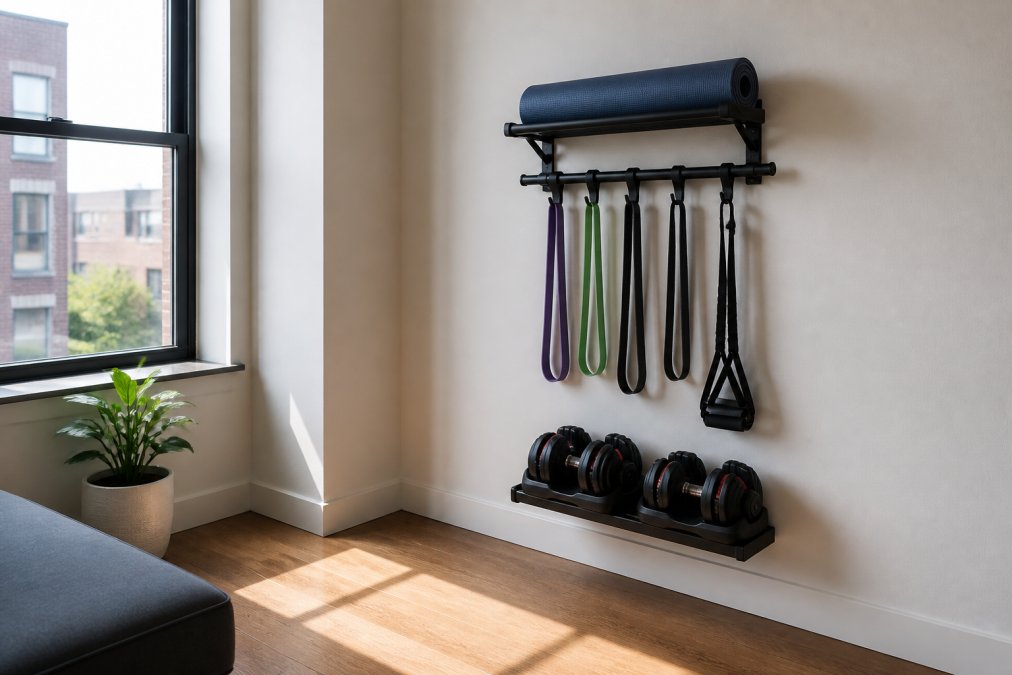
Try these storage solutions:
- Wall hooks for bands and jump ropes
- A tall narrow shelf for dumbbells
- Under-bed boxes for mats and rollers
- Over-door hangers for lighter gear
Layout Optimization: Zoning a Room That Has Another Job
Layout optimization means splitting one room into clear zones so your brain knows where work ends and training begins. Most guides stop at "use a corner". That is not a plan. Here is one you can actually draw.
Start With a Paper Floor Plan
Sketch the room to scale on graph paper, or use a free floor-plan tool. Mark every fixed element: doors and their swing arcs, windows, radiators, built-in cupboards, plug sockets and light switches. Then mark the furniture you cannot move. What is left is your real training footprint.
The Three-Zone Rule
Divide the room into three bands, not two:
- Living zone, sofa, desk, TV, anything with a soft edge.
- Training zone, the mat, the bench footprint and the standing area for your heaviest lift.
- Transit zone, the 60cm channel that connects the door to both of the above.
The transit zone is the one people forget. If your training zone blocks the path to the door or the window, the room will feel cramped even when the equipment is small.
Use the Largest Movement as Your Anchor
Find the single biggest movement in your programme and give it the best spot. If you overhead press, you need 1.5m x 1.5m of floor and 2.2m of clear height. If you skip, you need 2m x 2m and 2.4m of height. Everything else fits around that anchor.
A practical order of priority:
5 in 1 Abdominal Muscle Training →
- Anchor the largest movement against a solid wall, not a window.
- Put storage on the wall opposite the anchor so you never walk through your lifting space to reach a band.
- Keep the mat rolled at the edge of the training zone, not in the middle of the transit zone.
Psychological Zoning in Practice
Psychological zoning is the habit of giving the room a physical cue that means "training now". It sounds soft, but it works because it removes the decision of where to start.
- A dedicated mat. Unroll it and the room changes purpose. Roll it up and the room goes back.
- A single light source. A clip-on lamp aimed at the training zone, switched on only for sessions, is a stronger cue than overhead lighting.
- Facing direction. Face the wall or the window, not the TV or the desk. You are far less likely to drift into other tasks.
- A closing ritual. When the session ends, every item goes back to its wall or shelf. The room resets, and so does your head.
Worked Example: Living Room by Day, Gym by Evening
- 18:00, move the coffee table 40cm to the left, into the living zone.
- 18:01, unroll the mat along the window wall.
- 18:02, lift the folding bench from behind the sofa and set it on the mat.
- 18:03, clip the lamp on and start.
- 19:00, reverse the sequence. Total reset time: under two minutes.
You train better when the space tells you what to do. A drawn plan, three zones and a two-minute reset will do more for consistency than any extra piece of kit.
Noise, Light and Air in a Small Training Room
Most guides ignore noise, light and ventilation. These three decide whether a setup actually works in a flat, a shared house or a room above someone else's bedroom. This is the part of a home gym that gear lists never cover.
Noise: What Actually Travels
- Impact noise is a dropped dumbbell, a skipped rope, a box jump. It travels through the structure of the building, not the air. A rubber mat alone will not stop it.
- Airborne noise is music, a fan, the clatter of plates, your own breathing at the top of a set. It travels through gaps, doors and shared walls.
A simple rule: train heavy in the early evening, not late at night, and never drop a loaded bar on a bare floor.
Light: Make the Room Feel Like a Gym
A dark corner kills motivation. Small rooms also have less daylight, so lighting has to work harder.
- Layer it. Overhead light for the whole room, a focused lamp for the training zone, and a small light near your storage so you can find kit without turning on everything.
- Aim light at the wall, not your eyes. A lamp pointed at a pale wall bounces soft light across the room and makes a small space feel larger.
- Use daylight when you can. Train near a window during the day. If the window faces the street, a sheer blind gives privacy without killing the light.
- Keep the training zone brighter than the living zone. The contrast is a cue: this corner is for working.
Air: The One People Forget
A small room overheats fast. Twenty minutes of hard work in a closed 3m x 4m room can push the temperature up noticeably and leave the air stale and humid.
- Ventilate before, during and after. Open a window for five minutes before you start, keep a gap open during the session if the weather allows, and air the room for ten minutes afterwards.
- Move the air, don't just cool it. A pedestal or floor fan aimed across the training zone is more effective than a fan pointed at your face, because it keeps the whole zone moving.
- Watch the humidity. Damp air plus sweat plus stored rubber is how kit starts to smell. If the room has no extractor, a small dehumidifier in the corner will pay for itself in the life of your mats and bands.
- Do not block the radiator. If your only free wall is behind a radiator, use it for light storage only. Heat degrades rubber and adhesive.
The Five-Minute Environmental Check
Before you commit to a spot, run this once:
- Drop a book from waist height on the floor. Does it sound hollow and loud? You need decoupling.
- Stand in the corner at the time of day you will train. Is it bright enough to see your form in a mirror or phone camera?
- Close the door and do twenty star jumps. Is the air stale within a minute? You need airflow.
Get these three right and you will actually use the space. Ignore them and even a well-equipped gym becomes a room you avoid.
Building a Minimalist Home Gym Setup on a Budget
A minimalist home gym setup costs less than most people expect. You don't need machines. You need a few versatile items and a plan.
For low-impact cardio in a tight space, try:
- Skipping (with a mat to cut noise)
- Shadow boxing
- Step-ups on a sturdy box
- Resistance band circuits
Looking After Equipment in Tight Quarters
Equipment in small spaces wears faster. It gets knocked, stored badly and packed too tight. A little care goes a long way.
Frequently Asked Questions
How much floor space do I really need for a home gym?
Most people can train effectively in roughly 2 by 2 metres. That gives you enough room for a yoga mat, a weight bench and a standing area for presses or squats. The limiting factor is usually clearance rather than total floor area, so measure the space you need around each movement, not just the footprint of the equipment. A folding bench or half rack that packs away against a wall lets a smaller area do more work.
What are the best space saving home gym setup tips for a small bedroom?
Start with equipment that folds or stacks. A folding half rack, adjustable dumbbells, resistance bands and a roll-up yoga mat cover most training needs without a permanent footprint. Store everything on wall-mounted hooks or a tall narrow shelf so the floor stays clear. Keep one zone for training and return items to storage after each session, otherwise a small bedroom quickly stops feeling like a bedroom.
How do I stop home gym noise annoying neighbours in a flat?
Interlocking rubber floor padding under your training area absorbs most impact noise from weights and jumping. Avoid dropping loaded bars, and place a mat under any bench or rack feet. If you train in the evening, shift cardio to lower-impact options and keep the volume of any music reasonable. Padding plus controlled lifting technique handles the bulk of complaints before they start.
Which compact home gym equipment gives the most value first?
Adjustable dumbbells and a resistance band set cover the widest range of exercises for the least space and money. A foldable weight bench adds pressing and rowing options. Core tools such as an ab wheel set are cheap and store in a cupboard. Build up in that order, add a folding rack only once you know you will use it consistently, and you avoid buying equipment that ends up gathering dust.
Small flats make home training harder, but not impossible. The trick is measuring first, buying versatile gear, and treating storage and zoning as part of the setup. Metanoia media stocks compact fitness kit built for tight spaces, from foldable core trainers to rechargeable training belts, all at budget-friendly prices. Get started with Metanoia media and build a home gym that fits the room you actually have.