

How to Set Up a Home Workout Space: 2026 Guide

Table of Contents
- How to Set Up a Home Workout Space: Step-by-Step
- Step 1: Choose the Right Location and Measure Your Space
- Small Home Gym Ideas for Awkward or Tight Rooms
- Home Gym Equipment Essentials: What You Actually Need
- Home Gym Flooring: Protection, Noise and Vibration
- Budget Home Gym Setup: Cost Tiers and Total Spend
- Safety Checks, Lighting and Ventilation
- Conclusion
- Frequently Asked Questions
Last Updated: October 14, 2026
How to Set Up a Home Workout Space: Step-by-Step
Setting up a home workout space is the process of choosing a location, measuring the room, and picking equipment that fits how you actually train.
It takes most people a single weekend. The hard part is not the lifting. It is the planning.
Below, we show you exactly how to measure, choose, and lay out a home workout space that works for your room size, your budget, and your neighbours.
What You'll Need Before You Start
Gather a few things before you move a single dumbbell:
- A tape measure, at least 5 metres
- A notebook or phone for recording room dimensions
- Masking tape to mark out equipment zones on the floor
- A spirit level, if you plan to bolt anything down
- A friend, for anything heavy
You should also decide your main workout goal now. Strength training, cardio, and mobility work all need different floor space and headroom. Write it down before you shop.
Step 1: Choose the Right Location and Measure Your Space
Pick a spot with at least 2 metres of clear floor in each direction, a ceiling height of 2.4 metres or more, and a door wide enough to move equipment through. Then measure before you commit.
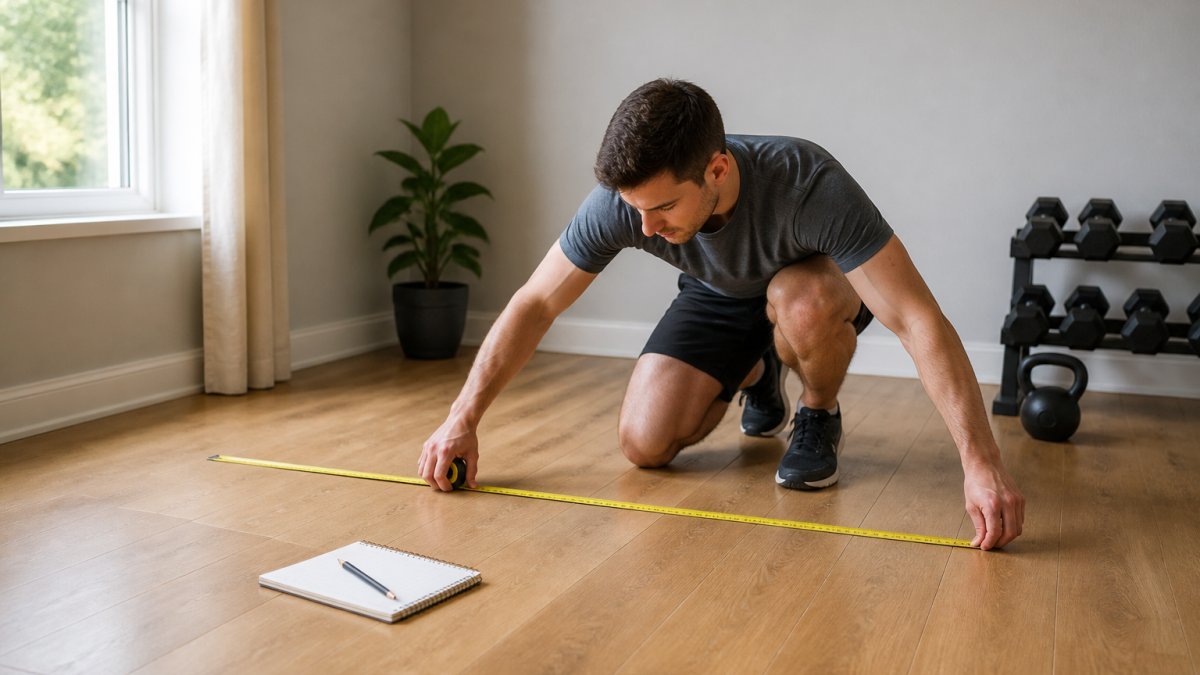
Walk around your home and shortlist two or three rooms. A spare bedroom, a garage corner, or a section of a living room can all work.
Measuring Floor Area and Checking Ceiling Height
Write down four numbers for each room: length, width, ceiling height, and door width.
- Floor area: multiply length by width. A 3m x 3m room gives you 9 square metres.
- Ceiling height: stand and reach overhead. Add 30cm for anything done above your head.
- Door width: most interior doors are around 76cm. A squat rack will not fit through anything narrower.
- Movement clearance: leave 60cm of free space on every side of any rack or bench.
If a room fails on any of these, cross it off. There is no workaround for a ceiling that is too low.
Small Home Gym Ideas for Awkward or Tight Rooms
Tight rooms reward clever layouts, not more kit. The most useful thing you can do is sketch a plan to scale before you buy anything, then tape the zones out on the floor. Below are four sample layouts, each matched to a room size and a training style, so you can copy the one closest to your space.
Sample layout 1: The corner setup (roughly 2m x 2m)
Best for a bedroom corner, a box room, or the end of a hallway.
- One folding or adjustable bench pushed into the corner when not in use
- One pair of adjustable dumbbells stored on the floor beside the bench
- A rolled mat standing upright against the wall
- Resistance bands on a hook behind the door
Training style: strength and mobility. Clear floor when packed away: almost the full 2m x 2m. The bench is the only item that needs 60cm of clearance on its long sides during use, so pull it out from the corner before you train and push it back after.
Sample layout 2: The spare-room setup (roughly 3m x 3m)
Best for a spare bedroom you can dedicate to training.
- A power rack or squat stand against one wall, bolted down if the floor allows
- A bench that slides under the rack when not in use
- A barbell and plate storage on a wall-mounted rack
- A mat zone in the remaining floor area for floor work
Training style: strength. This is the smallest footprint that comfortably takes a barbell. You need roughly 2.4m of ceiling height for overhead pressing and at least 60cm of clearance on all four sides of the rack.
Sample layout 3: The garage setup (roughly 5m x 3m)
Best for a garage or a large outbuilding.
- Cardio machine along one long wall, facing into the room
- Rack and bench along the opposite long wall
- Free-weight and accessory storage on shelving at the back
- A clear central strip kept permanently empty for movement
Training style: mixed strength and cardio. The central strip is the key detail. If you fill it with storage, you lose the room's main advantage.
Sample layout 4: The shared or family space
Best for a living room or a room used for something else most of the day.
- A storage bench or ottoman that doubles as seating and holds dumbbells and bands
- A wall-mounted pull-up bar that folds flat
- A single mat that rolls up and slides behind a sofa
- A wall-mounted rack for bands, ropes and a skipping rope
Training style: bodyweight, cardio and mobility. The rule here is that every item must have a home that is not the floor.
The rule that ties them together
If it does not fold, stack, or hang, it probably does not belong in a small home gym. Before you buy, measure the footprint of the item when stored, not just when in use. A treadmill that needs 2m of floor when running may need almost as much when folded, and a bench that stores upright still needs a wall to lean against.
Home Gym Equipment Essentials: What You Actually Need
Start with six items and add nothing else for the first month. An exercise mat, resistance bands, a skipping rope, one pair of adjustable dumbbells, a bench, and a pull-up bar cover almost every home workout.
That list handles strength training, cardio, and mobility without filling the room. Buy versatile gear first and specialist gear later, once you know what you actually use.
5 in 1 Abdominal Muscle Training Three-Wheel Abdomen-Wheel Rally Set →
Compact and Multifunctional Equipment That Saves Space
Multifunctional gear does the work of three items in the footprint of one.
We stock the 5 in 1 Abdominal Muscle Training Three-Wheel Abdomen-Wheel Rally Set at £27.99. It packs down to a 21cm x 21cm x 13.5cm box and weighs about 1.5kg, so it fits on a shelf when you are done.

Home Gym Flooring: Protection, Noise and Vibration
Rubber or foam flooring protects your floor, cuts noise, and reduces vibration that travels through the building.
Floor protection matters more than most people expect. Dropped dumbbells crack tiles.
- Rubber mats: best under free weights and racks. Durable and grippy.
- Foam tiles: cheaper, softer, and better for yoga or floor work.
- Interlocking tiles: easy to fit and easy to move if you rearrange the room.
If you are in an upstairs flat, put a thick mat under anything that vibrates. It is the cheapest fix you will ever make.
Budget Home Gym Setup: Cost Tiers and Total Spend
A basic home gym setup costs between roughly £150 and £400, depending on how much you buy at once. You can build it in stages and spread the cost.
| Tier | What You Get | Typical Spend |
|---|---|---|
| Starter | Mat, bands, skipping rope | £40-£80 |
| Core | Starter kit plus adjustable dumbbells | £150-£250 |
| Full | Core plus bench and pull-up bar | £300-£400 |
Start at the tier that matches your space, not your ambition. A starter kit you actually use beats a full setup gathering dust.
Safety Checks, Lighting and Ventilation
Safety in a home gym comes down to four measurable things: clearance, stability, load, and air. Check each one before your first session, and re-check whenever you move equipment.
Movement clearance and overhead space
Leave 60cm of free floor on every side of any rack, bench, or machine. For a barbell, measure the bar itself: a standard Olympic bar is about 2.2m long, so a rack needs roughly 2.2m of clear width plus a little room to load plates.
Tape the zones out on the floor first. It is the cheapest way to see a layout problem before it becomes an injury.
Equipment stability and load limits
- Bolt down or weight down anything that could tip: racks, pull-up bars, and tall storage units.
- Check the manufacturer's stated load limit before you add plates or hang from a bar. Do not exceed it.
- A freestanding pull-up bar in a door frame relies on the frame. Check the frame is sound and the bar is rated for your body weight plus movement.
- Stack plates and dumbbells low and against a wall, not on a high shelf where they can fall.
- If you are renting, use freestanding or wall-mounted options that do not require drilling, and check your tenancy agreement before fixing anything to a wall.
Floor protection and vibration
Dropped dumbbells crack tiles. A treadmill or rower sends vibration straight into a wooden floor, and downstairs neighbours will hear it. Put a 6mm to 8mm rubber mat under weights and racks, and a thicker tile under cardio machines. In an upstairs flat, a thick mat under anything that vibrates is the cheapest fix you will ever make.
Lighting
Lighting should be bright and even. A single overhead bulb casts shadows that make lifting riskier because you cannot see your footing or the floor around you. Add a lamp or a second light source if the room feels dim, and avoid positioning a light directly behind where you stand so it does not shine into your eyes.
Ventilation and temperature
Ventilation keeps the room usable. Open a window, or add a fan, especially in a small room with no airflow. A stuffy room kills motivation fast and makes hard sessions harder. In a garage or outbuilding, check for damp and consider a dehumidifier if the room smells musty, because damp air damages rubber and metal equipment over time.
Power access
Check power access before you place a cardio machine. If it needs a socket, make sure one is within reach without a cable running across the floor. If you must use an extension lead, run it along a wall and tape it down, never across a walking path.
Conclusion
The hardest part of a home gym is not the equipment. It is resisting the urge to buy everything at once before you have measured the room.
At Metanoia media, we stock fitness gear built for exactly this problem: compact, multifunctional, and priced for a real budget.
Get started with Metanoia media and build a home workout space that fits your room, your routine, and your wallet.
Frequently Asked Questions
What size room do I need for a home gym?
You can set up a home workout space in as little as 2 metres by 2 metres if you stick to compact equipment. For free weights and a bench, aim for at least 3 metres by 3 metres so you have room to move around safely. Measure your floor area and ceiling height first, then check that you have at least 60cm of clearance on all sides of any equipment before you commit to a layout.
What equipment do I need for a home workout space?
Start with the basics: an exercise mat, resistance bands and a skipping rope cover most cardio and mobility work for under £50. Add a set of adjustable dumbbells and a kettlebell for strength training. If space allows, a foldable bench or a multifunctional tool like the 5 in 1 Abdominal Muscle Training Three-Wheel Abdomen-Wheel Rally Set (£27.99) gives you core, arm and leg options without eating up floor space.
What flooring is best for a home gym?
Rubber gym tiles or interlocking foam mats are the most practical choice for a home gym flooring setup. They protect your existing floor from dropped weights, reduce noise and vibration travelling to rooms below, and give you grip during workouts. For a budget option, a thick exercise mat under your main training area works well for bodyweight and band work. Avoid bare laminate or tile if you plan to lift weights.
How much does it cost to set up a home gym?
A basic budget home gym setup costs around £100 to £200 and covers a mat, resistance bands, a skipping rope and one or two small weights. Start with the essentials and add equipment as your training goals become clearer.