

Essential Fitness Gear for Beginners: 7 Must-Haves

Last Updated: October 23, 2026
Quick Summary
Essential fitness gear for beginners is a short list: supportive trainers, breathable gym clothes, a water bottle, a microfibre towel, and one or two pieces of equipment that match how you train. Buy for the sessions you will actually do next month, then add gear only when a specific need appears.
- Flat, stable shoes suit lifting and gym classes, while cushioned running shoes suit treadmill work.
- Pack trainers, a filled bottle, a microfibre towel, a padlock, and a change of clothes for your first session.
- A 500ml to 750ml bottle is enough for a typical session at most gyms.
- Adjustable dumbbells, resistance bands, and a mat cover presses, rows, squats, lunges, and core work.
- Skip grip gloves, wrist straps, and lifting belts until a specific joint or grip need appears.
Table of Contents
- Start With the Right Fitness Gear, Not the Most Gear
- What to Wear to the Gym: Clothing and Footwear That Work
- Gym Bag Essentials for Your First Session
- Strength Training Equipment for Beginners: The Short List
- Beginner Home Gym Equipment That Earns Its Space
- Budget Tiers: What to Buy First, Second, and Later
- Safety, Support Gear, and Looking After Your Kit
- Frequently Asked Questions
Start With the Right Fitness Gear, Not the Most Gear
The biggest mistake beginners make is buying a full kit before they have a single session behind them.
That is the throughline of this guide. Gear should follow your training, not the other way around. Below, we break down what to wear, what to pack, what to buy for a home setup, and how to spend in the right order.
A 2021 study on public fitness equipment experience led by Z. Zheng looked at what shapes user satisfaction with training equipment, and the takeaway is straightforward: how well gear fits the person using it matters more than how much gear there is. research on public fitness equipment experience
What to Wear to the Gym: Clothing and Footwear That Work
What you wear to the gym should let you move through a full range of motion without adjusting anything mid-set. That means breathable layers, bottoms that stay put, and trainers matched to your main activity. Clothing is the first thing to get right because it is the cheapest fix and the one you notice every session.
Trainers, Shorts, and Layers
Trainers are the single most important purchase. Flat, stable shoes suit lifting and most gym classes; cushioned running shoes suit treadmill work. Wearing running shoes for heavy squats is a common mistake, because the soft sole makes your ankles work harder to stay balanced.
For clothing, pick shorts or leggings that do not ride up, a T-shirt or tank that wicks sweat, and a light layer for warm-ups. A padded sports bra with removable cups reduces bounce during running and classes; our High Stretch Breathable Padded Sports Bra is cut for exactly that, and the zipped padded tank option suits anyone who prefers a front-fastening fit.


Gym Bag Essentials for Your First Session
Gym bag essentials fit in one small bag: trainers, a towel, a water bottle, a padlock for the locker, and a change of clothes. Everything else is optional.
Most commercial gyms provide the big-ticket items, so check before you pack. Free weights, resistance machines, cardio equipment, mats, and often hairdryers are standard.
What to leave at home is just as important.
Hydration deserves its own line. A refillable bottle you actually carry beats a fancy one you leave at home, and sipping through a session is easier than catching up afterwards.
A practical first-session checklist, in packing order:
- Trainers and socks (the pair you have already trained in, not a brand-new pair)
- Water bottle, filled
- Microfibre towel
- Padlock, if the gym does not provide one
- Change of clothes and a plastic bag for sweaty kit
- Headphones and a charged phone
- A note of your planned session, so you are not wandering between machines
Strength Training Equipment for Beginners: The Short List
Strength training equipment for beginners comes down to three things: a set of dumbbells or adjustable dumbbells, a resistance band, and a mat. That kit covers presses, rows, squats, lunges, and core work. You do not need a barbell, a bench, or a rack to start.
Choosing each piece well matters more than buying more of it. Here is what to look for.
Dumbbells and adjustable dumbbells. Fixed dumbbells are simple and robust but take up floor space and become expensive as you add pairs.
Resistance bands. Flat loop bands are the most versatile for beginners: they add variety for warm-ups, hip work, and shoulder stability, and they pack into a bag.
5 in 1 Abdominal Muscle Training Three-Wheel Abdomen-Wheel Rally Set →
Exercise mat. A mat protects your spine and elbows during floor work and gives grip for stretching. For home use, a 6mm to 10mm mat suits most people; thicker mats are softer but less stable for standing balance work.
| Equipment | What it covers | Approx. cost | Priority |
|---|---|---|---|
| Adjustable dumbbells | Presses, rows, squats | £40-£120 | First |
| Resistance bands | Warm-ups, hip and shoulder work | £10-£25 | First |
| Exercise mat | Floor work, core, stretching | £15-£30 | First |
| Kettlebell | Swings, carries, conditioning | £20-£50 | Second |
| Ab wheel set | Core and upper body | £27.99 | Later |
A kettlebell is worth adding if you like swings and carries, but it is not essential on day one. Our 5 in 1 abdominal training set is a good example of gear that earns its place later, once basic core work feels controlled.

Beginner Home Gym Equipment That Earns Its Space
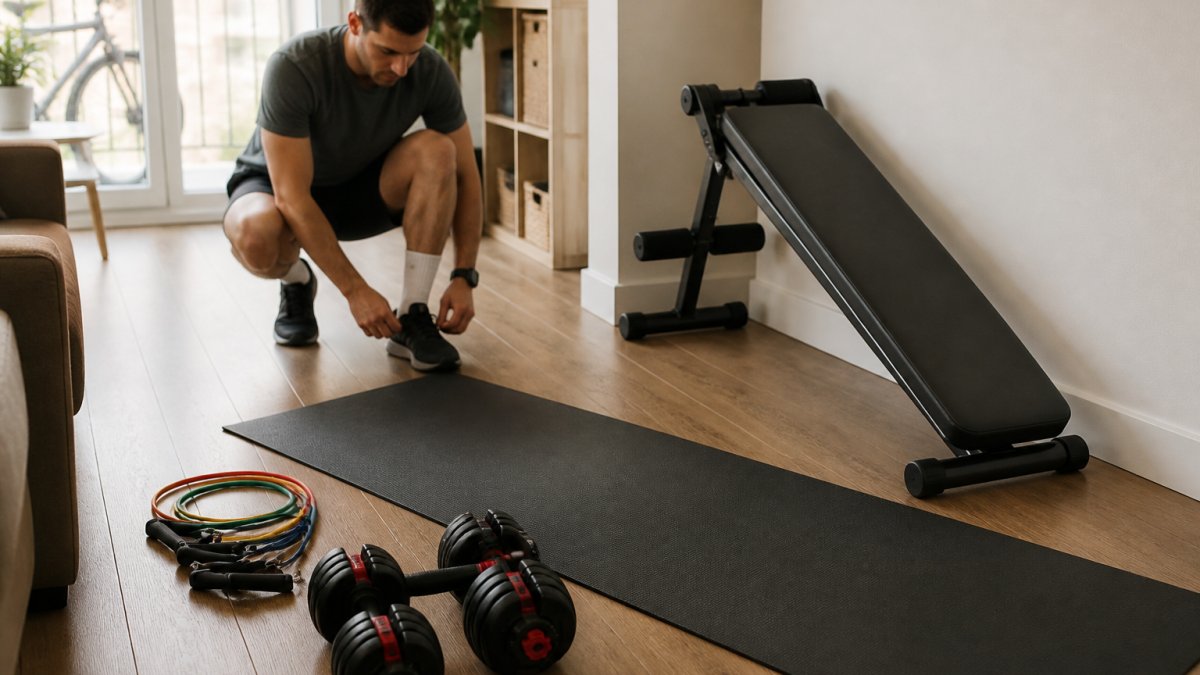
Beginner home gym equipment should fit the floor space you have left after the furniture, not the other way around. Measure your corner before you buy anything. Folding benches, adjustable dumbbells, and bands that hang on a hook are the pieces that survive in small flats.
Choosing by Training Goal and Room Size
Match gear to your goal first. Training for strength favours dumbbells and a bench; training for general fitness favours bands, a mat, and bodyweight work; training for cardio favours a jump rope or a compact cardio machine. Then check the footprint against your room.
If space is tight, our guides on home fitness equipment for small apartments, space-saving gym setups for small flats, and setting up a home workout space walk through the layout decisions in more detail.
Budget Tiers: What to Buy First, Second, and Later
Spending in tiers keeps you training without wasting money. Start with the items you use every session, then add gear when a specific gap shows up in your training.
| Tier | Buy | Why now |
|---|---|---|
| First | Trainers, gym clothes, water bottle, towel | Used every session |
| Second | Mat, resistance bands, adjustable dumbbells | Unlocks a full home workout |
| Later | Kettlebell, ab wheel, bench, cardio machine | Add when a goal requires it |
Most beginners overspend in the "later" tier and underspend on trainers. The reverse works better. A good pair of shoes and a mat will carry you through months of training; a bench you use twice a week will not.
Safety, Support Gear, and Looking After Your Kit
Support gear is for supporting an existing need, not for preventing one. Grip gloves, wrist straps, lifting belts, elbow sleeves, and knee braces are useful when grip, wrists, or joints limit your training, and unnecessary before that.
A common mistake is buying a lifting belt in week one. A belt helps you brace under heavy loads; it does not fix poor form, and wearing one for light work stops you building the stability you need.
Looking after your kit is simple. Wipe down mats and dumbbells after use, air out trainers, wash gym clothes after every session, and store bands away from direct sunlight so they do not perish.
Frequently Asked Questions
What fitness gear does a beginner really need?
You need less than most lists suggest. Start with supportive trainers, comfortable workout clothes, a water bottle, and one or two pieces of resistance equipment such as bands or a set of dumbbells. A microfibre towel and a small bag to carry it all completes the kit. Everything else can wait until you know your routine will stick. Buying a full home setup before your first month of training is the most common way beginners waste money on fitness gear.
What should I pack in a beginner's gym bag?
Gym bag essentials come down to eight items: trainers, a spare top, a water bottle, a microfibre towel, toiletries and cleansing wipes, a padlock for the locker, headphones, and a small snack. Keep a second set of underwear and socks in the bag so a forgotten item never derails a session. Pack the night before and leave the bag by the door. A bag that is ready to go removes the main excuse for skipping a workout.
Is it better to buy home workout equipment or join a gym?
It depends on space and how you train. A gym gives you heavy dumbbells, benches, and cardio machines without storing any of it. Home equipment suits people who train in short sessions, dislike commuting, or have a spare corner for a mat, bands, and adjustable dumbbells. Many beginners do both: a gym membership for strength work and a small home kit for busy days. Decide after a month of training, not before, so you know what you will actually use.
How much should a beginner spend on fitness equipment?
A sensible first kit costs well under £100 if you shop carefully. Clothing and trainers are the biggest line, then a water bottle and towel. Resistance bands and a mat are inexpensive, and a three-wheel ab roller set from Metanoia Media costs £27.99. Add dumbbells or kettlebells only once you have trained consistently for a few weeks. Spend on footwear first, since that is where cheap gear causes real discomfort, and keep the rest of the budget modest until your habits settle.
What strength training equipment is best for beginners?
Adjustable dumbbells, a set of resistance bands, and a kettlebell cover most beginner strength work. Adjustable dumbbells replace a whole rack and take up one corner. Bands are cheap, portable, and useful for warm-ups and辅助 exercises. A single moderate kettlebell handles swings, goblet squats, and carries. Add a bench only when your programme calls for pressing or rowing variations. Learn technique with light loads first, then add weight plates or heavier bells as your form improves.
What should I wear to the gym as a beginner?
Wear breathable layers you can move in and trainers suited to the session. Flat, stable shoes work best for lifting; cushioned running shoes suit cardio. Shorts or leggings plus a T-shirt cover most sessions, and a supportive sports bra matters for anyone doing jumping or running. Avoid brand-new shoes on a long cardio day and skip thick seams that rub under straps. Comfort beats style: if you are adjusting your clothes every set, they are the wrong choice.
The hardest part of starting is not choosing gear; it is buying just enough to begin and no more. Metanoia media stocks a range of fitness and lifestyle essentials, from padded sports bras to core training equipment, so you can build your kit in stages as your training grows. Start with the basics, add gear when a real need appears, and let consistency do the rest. View all to find your first pieces.
