

How to Verify Fitness Equipment Quality: 7-Step Guide

Table of Contents
- Why Verifying Fitness Equipment Quality Matters
- Your Home Gym Equipment Buying Checklist
- How to Inspect Exercise Equipment: A Step-by-Step Quality Check
- Fitness Equipment Safety Standards and Certifications
- Fitness Equipment Warranty and Returns: What to Check
- How to Assess Used or Refurbished Equipment
- Quality Checks by Equipment Type
- Conclusion
- Frequently Asked Questions
Last Updated: October 5, 2026
Why Verifying Fitness Equipment Quality Matters
Learning how to verify fitness equipment quality protects your money and your body.
This guide from Metanoia media breaks the process into seven clear steps.
Most shoppers judge by looks. A shiny frame tells you nothing about weld strength or motor quality.
Below, we show you how to inspect any machine, in any shop or showroom, in under ten minutes.
Your Home Gym Equipment Buying Checklist
A good home gym equipment buying checklist starts with your room, not the product. Measure first. Buy second.
Space and Equipment Dimensions
Check your available space first. Measure the floor area and ceiling height.
Then compare those numbers against the equipment dimensions on the product page.
- Treadmills: check both the running deck and the full frame length
- Multi-gyms: check the height of the top pulley
- Benches: check the length when fully flat
A compact design helps in small flats, but "compact" means nothing without numbers. Buy to the listed dimensions, not the marketing photo.
Fitness Goals and Resistance Options
Match the machine to your goal. For strength building, free weights and a solid bench beat most multi-gyms.
For resistance training, check the resistance levels on offer. Bands and stacks suit beginners; plate-loaded systems suit lifters adding weight over time.
How to Inspect Exercise Equipment: A Step-by-Step Quality Check
Most buying guides tell you to "check the build quality" and stop there. Work through the six stages below in order, and you will have a defensible verdict on any machine in under ten minutes.
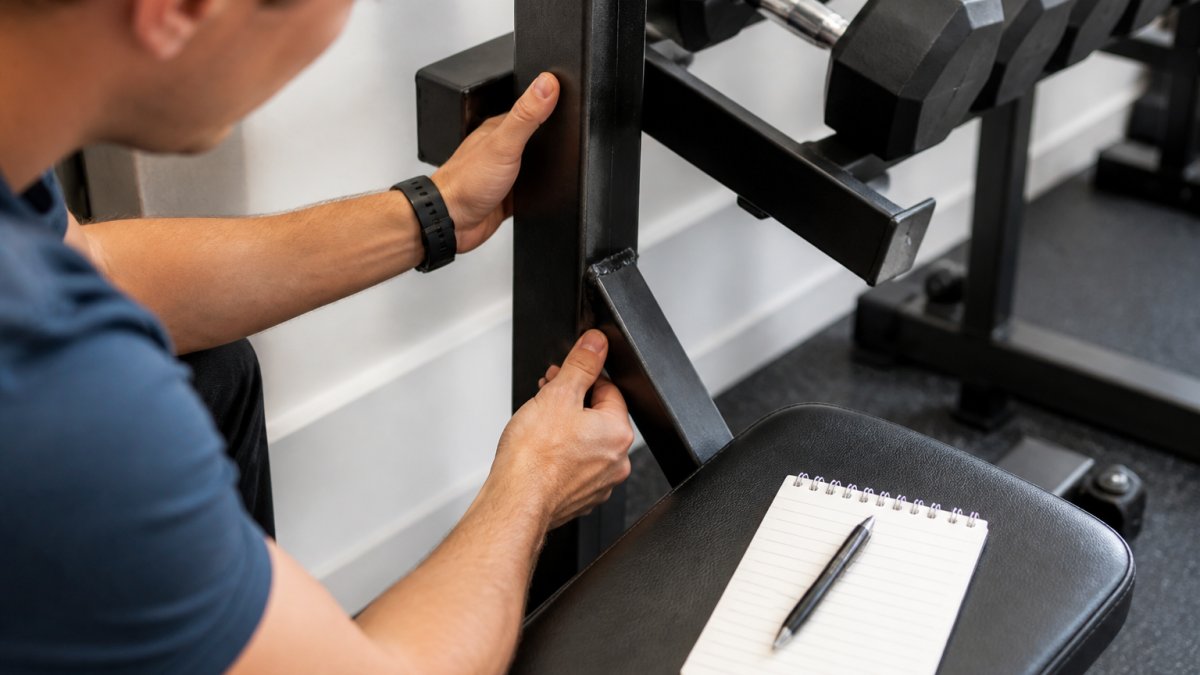
Stage 1: Paperwork before you touch anything
Before inspecting the item, confirm three things on the listing or label:
- The exact model number, not just the product family name
- The stated maximum user weight, and whether it is a tested rating or a marketing figure
- The standard the product claims to be tested against (see the safety section below)
If any are missing, treat the product as unverified. A seller who cannot name the model number cannot support you with parts later.
Stage 2: Frame and weld inspection
Start at the base and work up, checking every weld on the main frame, not just the ones facing you.
- Good welds are smooth, even beads with no porosity, no undercut, and no spatter. They are usually left unpainted so you can see them.
- Bad welds are lumpy, uneven, or hidden under thick paint or plastic covers. Paint over a weld is often a cover-up.
- Tube gauge: thin-wall tubing flexes under load. If the frame visibly bows when you press down on it, walk away.
Run your hand along the underside of the main beam. Sharp edges, burrs, or exposed bolt ends signal poor finishing and a cut risk.
Stage 3: Joints, fasteners, and fittings
Every bolted joint should be tight and use a locking mechanism, a nylon-insert lock nut, spring washer, or thread-locking compound. A plain nut on a vibrating machine will loosen.
Check that:
- Bolts are the correct length and not protruding into a moving path
- Plastic end caps and covers are seated, not cracked or loose
- Adjustment pins click positively into every hole, with no wobble once seated
Stage 4: Upholstery, stitching, and padding
On benches, pads, and mats, press the foam with your thumb. It should spring back quickly; foam that stays compressed will flatten within months.
Check seams at stress points, bench pad corners, weighted vest shoulders, rowing seat edges. Reinforced stitching (double-stitched or bar-tacked) stops a seam splitting under load.
Stage 5: Movement and resistance test
Move every moving part through its full range, slowly, then at training pace.
- Cables and pulleys: the cable should run true in the groove, with no fraying, no flat spots, and no rubbing on the frame.
- Belts: check the belt tracks centrally on the deck and does not drift to one side.
- Resistance: test the lowest and highest settings. Resistance should change smoothly, not in jumps or dead spots.
Stage 6: Stability, noise, and the shake test
This stage catches the most problems, yet most buyers skip it.
- Shake test. Push the frame side to side and front to back. Any flex, creak, or rocking is a red flag. A stable machine does not move.
- Load test. Stand, sit, or lean on the machine as you would in use. Listen for creaks from joints and watch for frame deflection.
- Noise test. Run or pedal at your normal pace. Rattles mean loose fittings or poor tolerances. Rhythmic thumps on a treadmill point to a worn belt or a failing bearing.
- Emergency stop. On any cardio machine, press the emergency stop and confirm it cuts power immediately. If it does not, do not buy.
If a shop will not let you run these tests, buy from a seller that lets you try the kit or offers easy returns.
Fitness Equipment Safety Standards and Certifications
"Meets safety standards" is a claim, not a fact. Your job is to verify it.
Which standards apply
In the UK, home fitness equipment is generally expected to meet the British and European standards for stationary training equipment, covering stability, strength, and safe use. The relevant family is the BS EN ISO 20957 series, split by equipment type, treadmills, exercise bikes, rowers, and strength machines each have their own part.
British and European safety standards for stationary training equipment
Ask the seller three questions:
- Which standard is this product tested against?
- Which test house or laboratory carried out the testing?
- Can you send me the test report or a declaration of conformity?
A serious brand answers all three; a brand that answers none is asking you to take its word.
What the standards actually cover
The standards address specific risks:
5 in 1 Abdominal Muscle Training Three-Wheel Abdomen-Wheel Rally Set →
- Stability: the machine should not tip when loaded and used as intended
- Strength: the frame and load-bearing parts should withstand the rated user weight with a safety margin
- Safe use: guards, covers, and pinch points should be designed out or protected
If the maximum user weight is not marked on the machine itself, treat the listing figure with caution.
Checking recalls and safety alerts
Before buying anything, new or used, search the product against the UK Government's product recall and safety alerts service. It takes two minutes and is free.
The UK Government's product recall and safety alerts service
Search by brand and model number, not just product type. A recall can apply to one production run and not another.
Safety features to verify in person
Standards and recalls are paperwork. These are the physical checks:
- Emergency stop: on treadmills and other cardio machines, confirm the stop cuts power immediately, and that the safety key or clip is present
- Guards and covers: moving parts, belts, and flywheels should be enclosed or guarded
- Pinch points: check where parts fold, adjust, or slide together
Certifications versus self-declaration
Some products carry a third-party certification mark; others rely on the manufacturer's own declaration of conformity. Both can be legitimate, but a third-party test report is evidence while a self-declaration is a promise. When the price is high or the machine is load-bearing, ask for the evidence.
Fitness Equipment Warranty and Returns: What to Check
A fitness equipment warranty is your proof the maker stands behind the build. Read the terms before you buy, not after something breaks.
Check these points:
- Length: Frame warranties usually run longer than parts and labour
- Coverage: Motors, bearings, and electronics are often excluded
- Labour: Does the warranty cover a technician visit, or just the part?
A short warranty on an expensive machine is a warning sign. So is a returns policy that makes sending the item back expensive or awkward.
How to Assess Used or Refurbished Equipment
Used kit can be a bargain if you know what to look for, but the risk is real.
Start with the frame: rust, cracks, and bent tubing are deal-breakers. Then check moving parts for play and grinding.
On refurbished cardio machines, ask about the motor, speed sensor, and calibration.
- Ask how old the machine is and how often it was used
- Check the belt, cables, and bearings for wear
- Ask whether parts were replaced, and which ones
Quality Checks by Equipment Type
Different kit fails in different ways. Here is what to check on each type.
Weights, Benches, and Multi-Gyms
On benches, check pad thickness and frame welds. Sit on it and shift your weight; it should not rock.
On dumbbells, check handle knurling and weight markings. On multi-gyms, test every pulley and cable, the cable should run true, with no fraying.
For a compact strength option, our 5 in 1 Abdominal Muscle Training Three-Wheel Abdomen-Wheel Rally Set at £27.99 has a 16cm wheel and a 32cm axle, plus a kneeling mat and resistance ropes.

Cardio Machines: Treadmills and Motors
On treadmills, the motor is the heart of the machine. Ask for the continuous duty rating, not the peak rating.
Check the belt for fraying and the deck for wear. Run it and listen for a rhythmic thump, which points to a worn belt or failing bearing.
If the machine has a display, check the speed sensor and calibration.
Small Accessories: Ab Wheels and Weighted Vests
Small kit is cheap to replace, but cheap kit still wastes money. On ab wheels, check wheel diameter and grip; a wider wheel is more stable for beginners.
On weighted vests, check stitching and closure, especially reinforced seams at the shoulder straps. A vest that splits mid-run is a hazard, not a tool.
- Check the wheel spins true, with no wobble
- Check the handles do not slip when your hands sweat
- Check the vest straps adjust and lock in place
Conclusion
Verifying fitness equipment quality comes down to a few repeatable checks: measure your space, match the kit to your goal, inspect the build, and test it in person.
At Metanoia media, we stock fitness gear for everyday home workouts, with competitive pricing and many tech, home, and fitness products.
Get started with Metanoia media and kit out your home gym with equipment you can trust. View all.
Frequently Asked Questions
How can you tell if fitness equipment is good quality?
Check the build materials, weld quality, and stability first. Look for reinforced stitching on pads, heavy-gauge steel frames, and smooth resistance mechanisms. Test for wobble by applying weight to opposite ends. A quality piece will feel solid with no rattles or flex. Also review the warranty length; longer coverage usually signals better fitness equipment quality.
What should you check before buying home gym equipment?
Before buying, measure your available space and compare it to the equipment dimensions. Confirm the weight capacity suits your needs and check resistance levels if applicable. Verify the return policy and warranty terms. For electrical items like treadmills, ensure the motor power matches your intended use. Finally, read the safety certifications and look for any product recalls.
How do you check whether fitness equipment is safe to use?
Inspect for sharp edges, loose bolts, and frayed cables. Test stability by pushing the equipment from multiple angles; it should not tip. Check that all locking pins and adjustment mechanisms engage fully. For electrical equipment, verify the plug and cord are undamaged. Follow the manufacturer's weight limits and always use safety clips on treadmills.
What should you look for in a fitness equipment warranty?
Look for a warranty that covers frame, parts, and labour separately, with clear durations. A lifetime frame warranty is a good sign; parts and labour often range from 1 to 3 years. Check if the warranty transfers if you sell the equipment. Also review the returns policy: how many days you have, who pays return shipping, and whether a restocking fee applies.