

How to Do HIIT at Home Without Noise

Last Updated: October 30, 2026
Quick Summary
To learn how to do hiit at home without noise, swap every jumping move for a quiet substitute, such as squat-to-calf raises instead of jump squats and step-out jacks instead of jumping jacks. Run 40 seconds of work and 20 seconds of rest on a thick mat, landing toe-first with bent knees.
- A standard format is 40 seconds of work followed by 20 seconds of rest, repeated for three to four rounds.
- Swap burpees for squat thrusts with no jump, stepping the feet back one at a time.
- A 10-minute session includes a two-minute warm-up, two four-minute rounds and a two-minute cool-down.
- Beginners should start with 20 seconds of work and 40 seconds of rest for the first week.
- Train on a thick mat, never directly on bare floorboards, and land toe-first with bent knees.
Table of Contents
- Why Quiet HIIT Works as Well as Jumping Workouts
- What You'll Need Before Your First Session
- Step 1: Build a No-Equipment HIIT Workout at Home
- Step 2: Swap Jumping Moves for a Low-Impact HIIT Workout Without Jumping
- Step 3: Run a 10-Minute Low-Impact HIIT Workout
- Quiet Home Workout Tips for Flats and Shared Homes
- Adapting Quiet HIIT for Beginners, Joints and Small Spaces
- Kit Up for Your First Silent Session
- Frequently Asked Questions
Why Quiet HIIT Works as Well as Jumping Workouts
You can get a serious workout without a single jump. High-intensity interval training, or HIIT, works by pushing your heart rate up in short bursts, and jumping is only one way to do it. A review of HIIT research published in PubMed Central found that HIIT delivers a strong stimulus for heart and metabolic gains while staying tolerable for most people. The intensity comes from effort, not from noise.
That matters if you live in a flat with thin floors. Jumping jacks and burpees send impact straight through the floorboards. Quiet versions keep the effort and drop the thud.
Many people want to train at home without annoying the neighbours. The good news: you do not need equipment or a gym to get there. Below, we show you exactly how to do HIIT at home without noise, step by step.
What You'll Need Before Your First Session
You need very little to start a no-equipment HIIT workout at home. Clear a space about two metres wide, put on supportive trainers or go barefoot on a mat, and keep water nearby. That is it.
A few basics make the session safer and quieter:
- A thick fitness mat to soften landings and absorb sound
- A towel for grip and sweat
- A timer or phone app for work and rest intervals
- Trainers with a soft sole if you have hard floors
If you are buying gear, it is worth knowing how to judge quality before you spend. Our guide on how to verify fitness equipment quality walks through what to check.
Step 1: Build a No-Equipment HIIT Workout at Home
Start with a simple structure: pick four to six bodyweight moves, then alternate short work intervals with rest. A standard format is 40 seconds of work followed by 20 seconds of rest, repeated for three to four rounds. That is your exercise circuit.
HIIT is a training method that alternates short bursts of hard effort with brief recovery periods. You control the intensity through speed and range of motion, so the same circuit works for beginners and regulars.
Choose moves that keep your feet close to the floor. Good options include squats, push-ups, standing cardio and controlled low cross runs. Build the circuit before you start the clock, so you are not improvising mid-session.
Step 2: Swap Jumping Moves for a Low-Impact HIIT Workout Without Jumping
The easiest way to cut noise is to replace every jump with a quiet substitute. A low-impact HIIT workout without jumping keeps the effort but removes the impact. DailyBurn's home HIIT guidance recommends swapping jump squats for squat-to-calf raises, burpees for squat thrusts without the jump, and high knees for fast standing alternatives.
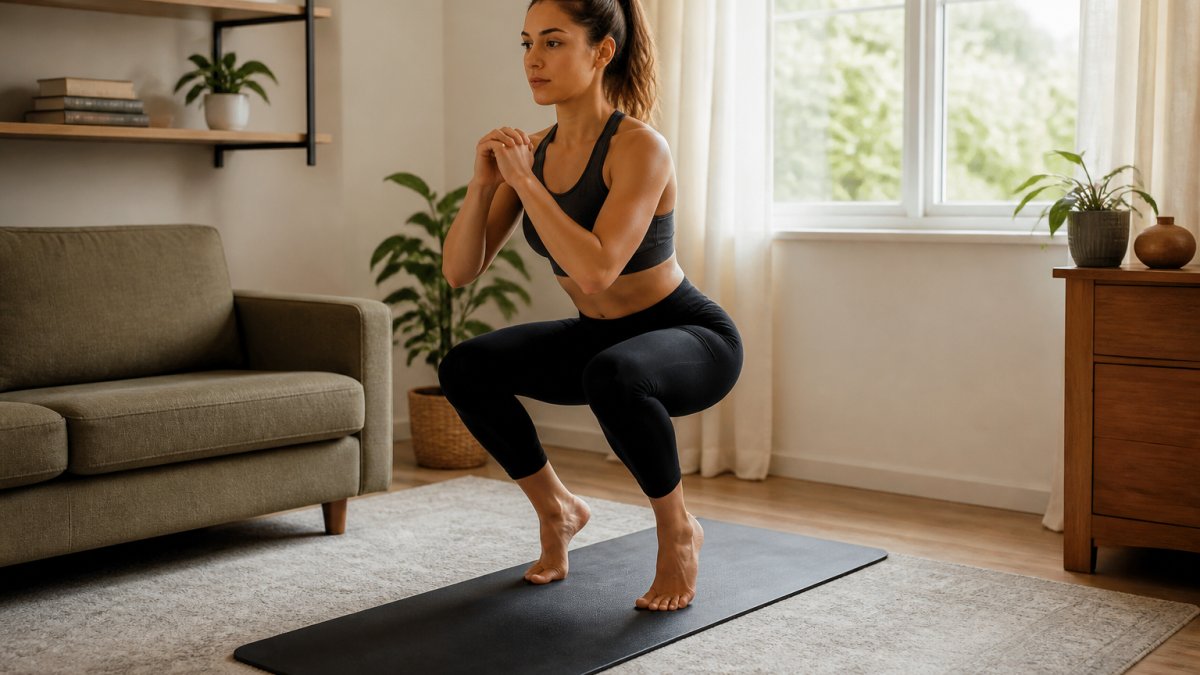
Here are some common swaps, with a quiet cue and an intensity dial for each:
- Jump squats → squat-to-calf raises. Quiet cue: rise onto the balls of your feet without leaving the floor. Intensity dial: slow the descent to three seconds and pause at the bottom.
- Burpees → squat thrusts, no jump. Quiet cue: step the feet back one at a time instead of hopping. Intensity dial: add a push-up at the bottom or widen the stance.
- Jumping jacks → step-out jacks. Quiet cue: step one foot out at a time and tap the floor softly. Intensity dial: increase arm range or add a light hand-weight press overhead.
- High knees → fast marching or standing knee drives. Quiet cue: drive the knee to hip height and place the foot down toe-first. Intensity dial: speed up the march or add a brief hold at the top.
- Mountain climbers → slow, controlled knee drives. Quiet cue: keep the hips low and slide the knee forward without bouncing. Intensity dial: increase tempo or extend the range.
Each swap keeps the work interval honest while your feet stay quiet. To preserve intensity without jumping, raise effort through tempo, range of motion, resistance (a water bottle or resistance band), and shorter recovery rather than adding impact. A simple perceived-exertion cue: you should be able to speak a short sentence but not hold a conversation during work intervals.
Noise level also depends on what is under you. Bare floorboards transmit more sound than a thick mat on carpet, and soft-soled trainers dampen vibration compared with bare feet on a hard floor. If you are unsure which surface is quietest in your home, test each swap for 20 seconds and listen from the next room.
5 in 1 Abdominal Muscle Training Three-Wheel Abdomen-Wheel Rally Set →
Step 3: Run a 10-Minute Low-Impact HIIT Workout
A 10-minute low-impact HIIT workout is enough for a solid session. Warm up for two minutes with dynamic stretches, then run the circuit below. Keep your movements controlled and land softly through the whole set.
| Block | Time | What to Do |
|---|---|---|
| Warm-up | 2 min | March in place, arm circles, leg swings, bodyweight squats (30s each) |
| Round 1 | 4 min | Squats (40s), push-ups (40s), step-out jacks (40s), squat thrusts (40s), with 20s rest between each |
| Round 2 | 4 min | Repeat the circuit in the same order, controlled pace |
| Cool-down | 2 min | Standing quad stretch, chest stretch, slow breathing |
Finish with a cool-down and light stretching to bring your heart rate down. The whole session fits in a small room and stays quiet enough for early mornings or late evenings, which is why PureGym's low-impact exercise guide points to no-jumping routines for home workouts.
Progression options: To make it harder without noise, shorten rest to 15 seconds, add a third round, or slow the tempo of each move. To make it easier, extend rest to 30 seconds or reduce work to 30 seconds. Beginners can start with 20 seconds of work and 40 seconds of rest for the first week.
Joint-sensitive adaptation: Keep the range of motion smaller, avoid deep squats, and perform push-ups on an incline (hands on a sofa or sturdy chair). Stop if you feel sharp pain or dizziness.
Quiet Home Workout Tips for Flats and Shared Homes
Noise travels through floors, so the fix is cushioning and control. These quiet home workout tips make a real difference in a flat or shared house:
- Train on a thick mat, never directly on bare floorboards
- Land toe-first and bend your knees to absorb impact
- Keep feet close to the ground on every move
- Choose controlled movement over speed
- Warn neighbours ahead if you train early or late
Small changes add up. A mat plus soft landings can cut most of the noise a downstairs neighbour would hear.
Adapting Quiet HIIT for Beginners, Joints and Small Spaces
Quiet HIIT adapts well to different fitness levels and rooms. Beginners should start with 20 seconds of work and 40 seconds of rest, then build up. If your joints are sensitive, keep the range of motion smaller and skip deep squats.
For small spaces, stay in one spot. Standing workout moves and step-out jacks need little room. A six-month study reported by ScienceDaily suggests HIIT may help older adults lose body fat while preserving muscle, so it is not just for the young or the fit.
Kit Up for Your First Silent Session
You can start a silent session with nothing but floor space, but a little kit helps. For a breakdown of affordable home fitness kit, see our Target vs Walmart fitness equipment reviews. A mat protects your joints and your floor. A timer keeps your intervals sharp.
If you want to add core work to your routine, our 5 in 1 abdominal training wheel set at £27.99 gives you a three-wheel abdomen wheel, kneeling mat, door buckle and rally ropes for home sessions. It suits yoga, home and gym use, and exercises the abdomen, arms and legs.

Frequently Asked Questions
Can you get an effective HIIT workout without jumping?
Yes. HIIT can provide a strong stimulus for cardiovascular work, and none of that depends on leaving the floor. You raise your heart rate by shortening rest intervals and moving with control: fast squats, squat thrusts without the jump, and standing cardio like low cross runs. A common approach is replacing jump squats with squat-to-calf raises and burpees with non-jumping squat thrusts. Keep work intervals at 30 to 40 seconds and rest at 15 to 20 seconds to hold the intensity.
How do I reduce workout noise in an upstairs flat?
Start with the surface. A thick fitness mat over a rug absorbs most of the contact noise from standing cardio and floor work. Replace every jumping move with a stepping or squatting version, land toe-first and keep your knees soft. Keep your circuit in one spot rather than moving around the room, and avoid dropping weights or slamming equipment down. No-jumping exercises can suit home workouts at any hour, including early mornings and late evenings, when noise matters most.
How long should a quiet HIIT workout last?
Ten to twenty minutes is enough for a full session. A simple structure is a five-minute dynamic warm-up, then three to four rounds of four exercises at 30 seconds work and 20 seconds rest, then a cool-down with stretching. If you are new to HIIT, start with two rounds and add one each week. Building duration gradually is a sensible approach, so avoid jumping straight into a 30-minute circuit.
Do I need equipment for a quiet HIIT workout?
No equipment is required. Bodyweight moves like squats, push-ups, standing cardio and controlled squat thrusts cover a full circuit. Two extras make it more comfortable and quieter: a fitness mat to cushion floor work and absorb impact, and a timer or interval app on your phone. If you want to add core work, the 5 in 1 Abdominal Muscle Training Three-Wheel Abdomen-Wheel Rally Set from Metanoia Media costs £27.99 and includes a kneeling pad, and includes a kneeling pad.
Getting started is the hard part, not the noise. Metanoia media stocks fitness gear built for home routines, from mats to core trainers, with competitive prices and a wide range of everyday essentials. Browse the fitness range, kit up, and turn your living room into a quiet training space. Get started with Metanoia media and train hard without waking the neighbours.
