

Choosing the Right Size Dog Bed: A Complete Guide

Table of Contents
- Why Dog Bed Size Matters More Than You Think
- How to Measure a Dog for a Bed
- Dog Bed Size Chart: Matching Measurements to Bed Dimensions
- The Best Dog Bed for Sleeping Position
- Dog Bed Size for Puppies and Growing Dogs
- Bed Shape, Material, and Orthopedic Support
- Accessibility and Household Constraints
- Frequently Asked Questions
Last Updated: October 14, 2026
Why Dog Bed Size Matters More Than You Think
A dog bed that's too small forces your dog to sleep in a cramped position, which can lead to stiffness and poor rest.
Below, we'll show you exactly how to measure your dog, read a size chart, and match bed shape to sleeping style. But first, here's what most guides get wrong: they tell you to measure your dog standing up.
How to Measure a Dog for a Bed
Most guides tell you to measure a dog standing up and add a few centimetres. That produces a crate mat, not a bed. A dog changes shape when it sleeps, so the measurement that matters is the one taken in the position your dog actually adopts overnight. The method below is repeatable, uses only a soft tape measure and a flat surface, and gives you two numbers to take shopping: a relaxed body length and a sleep span.
Step 1: Measure relaxed body length
Wait until your dog is lying down and settled, ideally after a walk when muscles are loose. Place the tape from the base of the tail to the furthest forward point of the body, usually the tip of the front paws if the legs are extended, or the tip of the nose if the head is stretched out. Record this in centimetres.
Step 2: Measure sleep span in the dog's dominant posture
Watch your dog for three nights and note which posture it holds for the longest stretch. Then measure that posture directly:
- Curled sleeper: measure the diameter of the curl, from the outside of the back to the outside of the tucked paws. A curled dog often needs only 60-70% of its relaxed body length.
- Sprawled sleeper: measure from the tip of the front paws to the tip of the back paws with the legs extended. This is usually 120-140% of relaxed body length.
- Side sleeper: measure from the base of the tail to the tip of the nose with the spine straight. This is close to relaxed body length, plus a few centimetres for the head to rest flat.
Step 3: Add clearance for movement and bedding
Add a clearance margin to the sleep span before you check any chart:
- Curled sleeper: add 5-10 cm so the dog can shift without pressing against a wall.
- Sprawled or side sleeper: add 10-15 cm so legs and head are fully supported.
- Senior or arthritic dog: add 15-20 cm so the dog can reposition without a struggle, and prioritise a low entry height over extra width.
Step 4: Convert to a bed size
Take your final figure, sleep span plus clearance, and compare it against the internal sleep area of a bed, not the outer footprint. If your dog falls between two chart sizes, size up. A bed that is slightly too large is usable; a bed that is slightly too small is not.
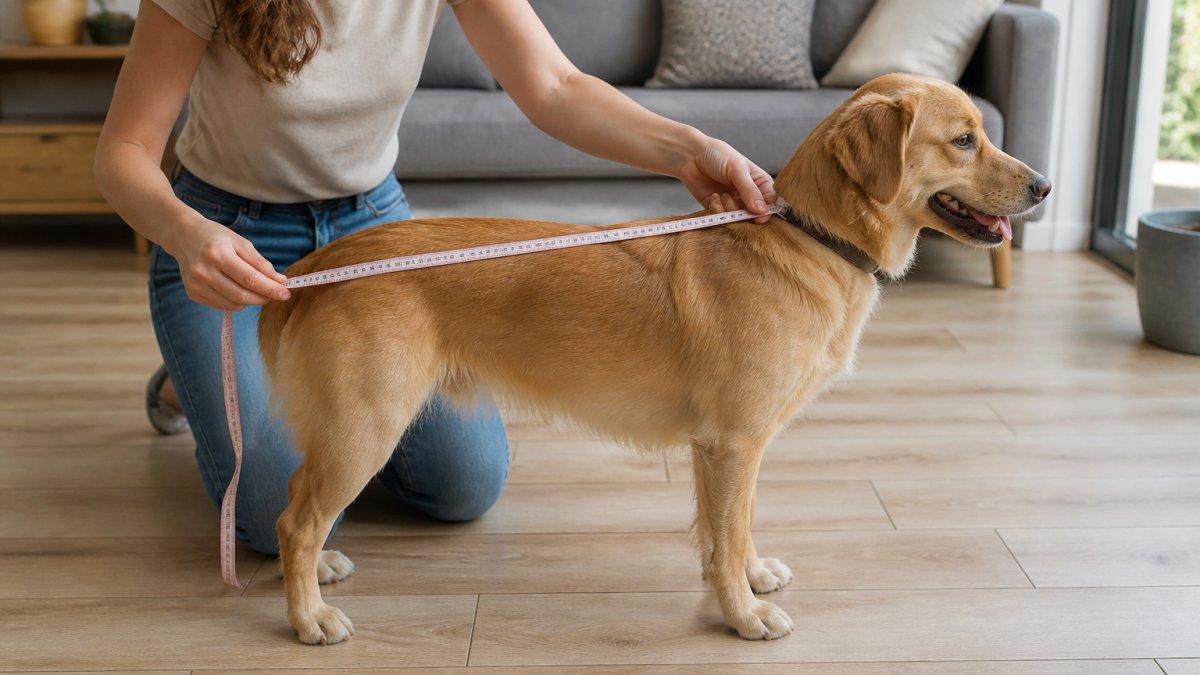
Worked example
A 55 cm body-length dog that sprawls on its side each night: relaxed length 55 cm, sleep span 70 cm, plus 12 cm clearance = 82 cm internal sleep area. A bed listed as "large, 80 x 60 cm external" may offer only 65 x 45 cm internally once bolsters are subtracted, too small. The correct choice is a bed with at least 82 cm of internal length, which often means an extra-large flat bed rather than a large bolster bed.
Dog Bed Size Chart: Matching Measurements to Bed Dimensions
A dog bed size chart is a starting point, not an answer. Breed charts assume a typical individual of that breed, but dogs within the same breed can differ by 15 cm or more in body length. Use the chart below to find your nearest size band, then apply the decision rules underneath to adjust for your dog's actual proportions and sleep style.
| Dog Body Length | Suggested Internal Sleep Area | Typical Bed Size |
|---|---|---|
| Up to 40 cm | 50 x 40 cm | Small |
| 40-55 cm | 65 x 50 cm | Medium |
| 55-70 cm | 80 x 60 cm | Large |
| 70-85 cm | 95 x 70 cm | Extra large |
| Over 85 cm | 110 x 80 cm | Giant |
Internal vs external bed dimensions
External dimensions describe the whole bed, including bolsters and frames. Internal dimensions describe the flat space your dog actually sleeps on. A bed listed as 80 cm wide might offer only 60 cm of usable sleep area once you subtract thick side walls. When a listing only gives one number, assume it is the external measurement and ask the seller for the internal figure before buying.
Why breed charts are only a starting point
Breed charts are useful for a first estimate, but they fail in three common cases:
- Dogs between sizes: a dog measuring 56 cm sits just inside the large band, but a sprawled sleeper needs the extra-large internal area. Size up when the sleep span plus clearance crosses a band boundary.
- Unusual proportions: a dog with a long back and short legs (such as a dachshund cross) needs a bed sized by body length, not height. A dog with a deep chest (such as a boxer) needs extra width so the ribcage is not compressed against a bolster.
- Mixed breeds: without a reliable adult size, measure the dog as it is now and add 10-15% if it is under 12 months old, or ask the vet for an adult-size estimate based on current weight and paw size.
Decision rules for the tricky cases
- Between two sizes: choose the larger internal sleep area. A bed that is slightly too big is usable; one that is slightly too small is not.
- Curled sleeper between sizes: you can stay at the smaller size if the internal area is at least the curl diameter plus 5 cm. Bolster beds often work here because the raised edge gives the dog something to press against.
- Sprawled sleeper between sizes: always size up. A flat bed with no bolsters maximises usable internal area for the same external footprint.
- Senior or mobility-limited dog: prioritise a low entry height (under 15 cm) and a firm, supportive base over extra width. A bed that is easy to step into gets used; a deep, high-sided bed does not.
- Puppy still growing: buy for the expected adult internal sleep area, or choose a bed with a removable bolster or an adjustable base so the usable area can grow with the dog. A cheap small bed replaced at six months usually costs more than one correctly sized bed bought once.
A quick comparison tool
Before you buy, write down four figures: relaxed body length, sleep span, clearance, and available floor space. Compare the first three against the bed's internal dimensions, and the fourth against the bed's external footprint. If all four fit, the bed is the right size. If any one does not, move to the next size up or choose a different shape.
The Best Dog Bed for Sleeping Position
The best dog bed for sleeping position depends on how your dog lies down, not how big they are. Curlers want a snug, enclosed shape; sprawlers need a flat, open surface with room to stretch.
- Curled-up sleeper: a bolster or donut bed with raised edges gives them something to press against and feel secure.
- Sprawled-out sleeper: a flat or pillow bed with a wide, even surface lets them stretch all four legs out.
- Side sleeper: a mattress-style bed with good cushioning supports the spine along its full length.
Watch your dog for a few nights before you buy. Their sleeping habits tell you more about the right shape than any breed chart will.
Dog Bed Size for Puppies and Growing Dogs
A dog bed size for puppies should account for adult size, not current size. Puppies can double or triple in weight during their first year, so a bed that fits today may be outgrown within months.
There are two sensible approaches. Buy a bed sized for the expected adult breed, accepting that a young puppy may rattle around in it at first.
If you're unsure how large your puppy will get, ask your vet or breeder for the parents' adult size.
Bed Shape, Material, and Orthopedic Support
An orthopedic bed uses denser foam to spread weight and reduce pressure on joints, which matters most for older dogs and larger breeds.
- Flat beds: simple, easy to wash, best for sprawlers and warm rooms.
- Bolster beds: raised sides for curlers and dogs that like to lean.
- Crate beds: thin mats sized to fit inside a crate, useful for travel and house training.
For materials, look for a removable, washable cover and a base that holds its shape after washing. For senior dogs with joint issues, a memory-foam or orthopedic base with a low entry height makes getting in and out easier.
Accessibility and Household Constraints
Accessibility and available space decide the final size as much as your dog's measurements do.
Measure the floor space where the bed will live before you shop. Leave a clear walking path around it, and check it fits against a wall or in a corner if your dog likes to feel enclosed.
If space is tight, a crate bed or an elevated bed with a smaller footprint can work better than a large flat bed.
Frequently Asked Questions
How do I measure my dog for a bed?
Measure from the base of the collar to the base of the tail while your dog stands. Add 15-20 cm for curled sleepers and 25-30 cm for dogs who stretch out. Also measure height from floor to shoulder and weight. These three numbers let you match any dog bed size chart accurately.
How much bigger should a dog bed be than my dog?
A bed should give your dog enough room to lie in their natural sleeping position without hanging over the edges. For curled sleepers, 15-20 cm of extra length works well. For dogs who sprawl, add 25-30 cm. If your dog is between sizes, always size up rather than down.
How do I choose a bed size for a puppy?
Puppies grow quickly, so buy for their expected adult size rather than their current measurements. Check the breed's typical adult weight and height, then choose a bed that will accommodate that. A bed that is too large can feel insecure for a young puppy, so consider a smaller bed now and upgrade as they grow.
Can a dog bed be too big?
Yes. A bed that is far too large can make a dog feel exposed and insecure, particularly puppies and smaller breeds. It also takes up unnecessary floor space. Aim for a bed where your dog can stretch out comfortably but still feel cosy and contained.
How do I use a dog bed size chart?
Find your dog's body length and weight on the chart, then check the bed's internal dimensions rather than the external ones. Internal measurements tell you the actual sleeping space. If your dog sits between two sizes, pick the larger option, especially for seniors or dogs with joint issues.
What size bed does my dog need if they curl up to sleep?
Curled-up sleepers need less space than sprawlers. Measure your dog's body length, add 15-20 cm, and look for a round or bolster bed with raised edges. These shapes suit dogs who like to nest and feel secure, and they take up less floor space than a large flat bed.
Getting the size wrong is the most common reason a dog bed sits unused in the corner. Metanoia media stocks a range of dog accessories, including functional beds built for comfort and everyday use, so you can match measurements to a bed that actually fits. Browse our dog accessories to find a size that suits your dog's posture, age, and space, and view all our everyday essentials while you're there. Get started with Metanoia media and give your dog a bed they'll choose over the sofa.