

Best Orthopedic Dog Beds for Joint Pain: 2026 Guide

Table of Contents
- What Makes a Dog Bed Orthopedic?
- Memory Foam Dog Bed Benefits for Joint Pain
- Signs of Arthritis in Dogs: When to Upgrade Their Bed
- Key Features to Compare in Orthopedic Dog Beds
- Bed Height and Accessibility for Senior Dog Mobility
- Supporting Joint Health Beyond the Bed
- Conclusion
- Frequently Asked Questions
Last Updated: October 1, 2026
What Makes a Dog Bed Orthopedic?
An orthopedic dog bed is a bed built around dense support foam rather than loose stuffing, designed to spread a dog's weight evenly and reduce pressure on joints. At Metanoia media, we stock joint supplements for dogs. Does the bed actually matter? It does, but only if the foam inside it is dense enough to hold its shape under a sleeping dog.
That distinction is the whole game.
Foam Density and What It Means for Support
Foam density is measured in kilograms per cubic metre, and it decides how well a bed resists collapsing under repeated weight. Low-density egg crate foam feels soft on day one and flattens fast, which is why it suits young, healthy dogs and not seniors. High-density memory foam holds its structure, distributes weight across a wider surface, and keeps the spine level through the night.
Memory Foam Dog Bed Benefits for Joint Pain
Memory foam dog bed benefits come down to pressure point relief. The foam moulds to a dog's body shape, spreading weight away from hips, elbows and shoulders instead of concentrating it at the contact points. For a dog with arthritis, that difference shows up in how easily they rise after a nap.
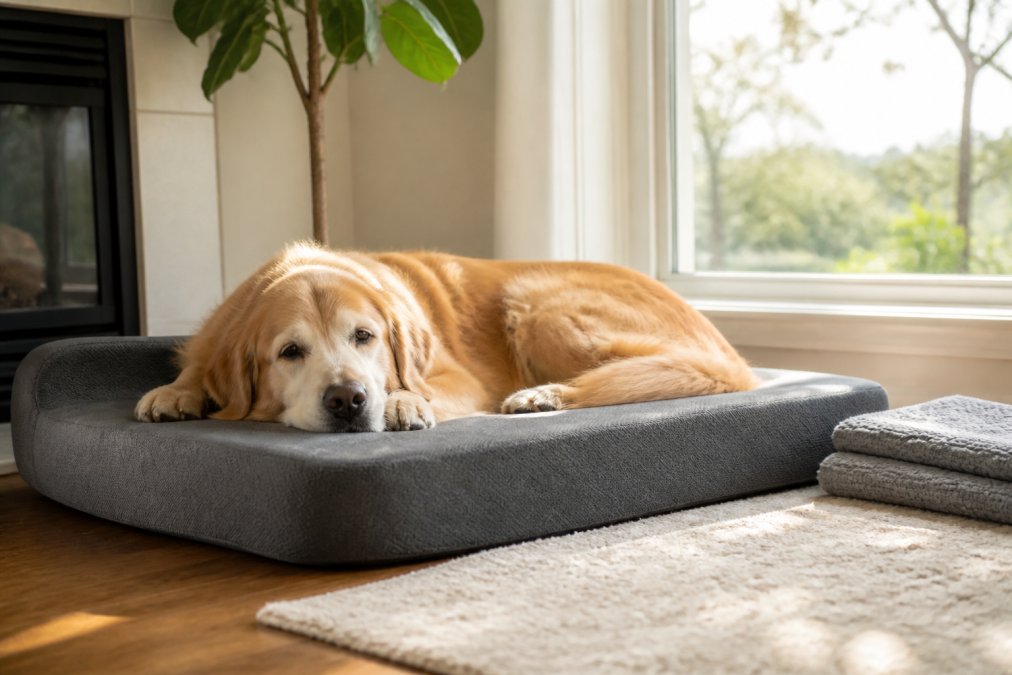
Pressure Point Relief and Spinal Alignment
Pressure point relief and spinal alignment work together. When a bed sags in the middle, the spine dips and the hips take load they shouldn't. A firmer, high-resilience base keeps the body level, which matters most for dogs with hip dysplasia support needs. The trade-off: very firm foam can feel unyielding to a light dog, so match firmness to body weight rather than assuming firmer is always better.
Signs of Arthritis in Dogs: When to Upgrade Their Bed
Signs of arthritis in dogs usually appear gradually, which is why owners miss them. Watch for stiffness after rest, reluctance to climb stairs, slower walks, or a dog that shifts position repeatedly before settling. A dog that once jumped onto the sofa and now hesitates is telling you something. If your dog is stiff for the first few minutes after getting up, their current bed may be part of the problem rather than just their joints.
Key Features to Compare in Orthopedic Dog Beds
Most guides tell you to look for 'support' and 'washability' and stop there. That is not enough to choose between two beds that both claim to be orthopedic. Compare six things instead: foam density, foam grade, cover construction, base grip, overall dimensions and the foam's safety certification and heat behaviour.
| Feature | What Good Looks Like | What to Avoid |
|---|---|---|
| Foam density | 30-45 kg/m³ for medium and large dogs | Anything unlabelled or under 25 kg/m³ |
| Foam grade | Viscoelastic memory foam, or memory foam over a high-resilience base | Egg crate or 'orthopedic' shredded fill |
| Cover construction | Removable, zip-off, machine washable at 30°C | Covers that cannot be removed |
| Waterproof liner | Internal TPU or PU barrier between foam and cover | Covers with no inner barrier |
| Base grip | Rubberised or silicone-dotted underside | Smooth fabric undersides |
| Dimensions | Length equal to your dog's nose-to-tail measurement plus 15-20cm | Beds sized to curled-up length |
Foam Density and the Weight-to-Density Rule
Density is measured in kilograms per cubic metre (kg/m³), and it is the single best predictor of whether a bed will still support your dog in a year. As a working rule, match density to body weight: a small dog under 10kg can be comfortable on 25-30 kg/m³, a medium dog of 10-25kg needs roughly 30-35 kg/m³, and a large or giant breed over 25kg generally needs 35-45 kg/m³ to avoid bottoming out.
Memory Foam vs. Egg Crate Foam
Egg crate foam is convoluted, low-density polyurethane. It feels soft because it has less material per cubic centimetre, and that is exactly why it collapses. It suits a young, healthy dog as a cheap comfort layer and nothing more. Memory foam (viscoelastic polyurethane) is denser, responds to body heat and pressure, and returns slowly to shape, the mechanism that spreads load away from hips, elbows and shoulders.
Waterproof Liners, Removable Covers, and Non-Slip Bases
A waterproof liner sits between the foam and the outer cover and is the single feature that extends a bed's working life most. Foam that gets wet grows mould and loses density, and a senior dog that cannot hold on through the night will soak a bed faster than an owner expects. Look for an internal TPU or PU barrier rather than a 'water-resistant' outer fabric, which only buys you minutes.
Material Safety and Off-Gassing
Polyurethane foams can contain flame retardants and can release volatile organic compounds (VOCs) when new, the 'new bed smell' owners notice. In the UK, furniture and furnishings are regulated for fire safety under the Furniture and Furnishings (Fire) (Safety) Regulations 1988 (as amended), and pet beds sold as furnishings fall within scope. That means a compliant bed has passed a flammability test, but it does not automatically tell you which flame retardant was used.
Temperature Regulation
Dense memory foam traps heat, and heat can aggravate inflamed joints, the opposite of what you want from a bed bought for joint pain. Two features mitigate this: a cooling gel layer or phase-change material infused into the top foam layer, and breathable covers such as 3D mesh or bamboo-viscose blends rather than non-breathable polyester. If your dog runs hot or the bed sits near a radiator, a cooling layer is worth more than an extra centimetre of foam.
Leap Plus Joint Tablets (60) - Global →
Bed Height and Accessibility for Senior Dog Mobility
Bed height is a feature that decides whether a senior dog uses the bed at all. A bed that is too thick forces a stiff dog to step up, straining hips and shoulders; a bed that is too thin offers no cushioning. The practical answer is a low-profile orthopedic bed with a firm edge your dog can lean on while getting up, or a bolster they can push against.
Step-Up Height: The Number Nobody Gives You
As a working guide, aim for a sleeping surface no more than 10-15cm above the floor for a dog with significant arthritis or hip dysplasia, and no more than 20cm for a dog with mild stiffness. Anything above 25cm effectively becomes a step your dog has to climb, and many seniors will simply stop using it. Measure from the floor to the top of the compressed foam, not the uncompressed height on the product page, which is usually 2-4cm higher once a dog lies on it.
Bolsters, Edges and Getting Up
A dog with weak hindquarters pushes up with its front legs first. A firm bolster or raised edge gives those front paws something to brace against, which reduces the effort of standing. Look for a bolster that is firm enough to hold its shape under a leaning dog, soft, overstuffed bolsters collapse and offer no leverage. For dogs that circle before lying down, a bed with a low, continuous rim rather than a high-walled nest is easier to enter and exit.
The Durability Test Before You Buy
Beds flatten, and flattening is a common complaint owners raise about orthopedic beds after a few months. You can screen for it before buying with three checks. First, press the foam flat with your palm and hold for five seconds, good memory foam recovers slowly over two to three seconds; cheap foam springs back instantly or stays compressed.
Supporting Joint Health Beyond the Bed
A good bed manages comfort overnight; it doesn't address joint health on its own. Veterinary guidance generally points to weight management, gentle daily movement and joint support as the pillars of arthritis management at home. Keeping your dog at a healthy weight reduces load on every joint, and short, regular walks keep mobility up better than occasional long ones.
Conclusion
Choosing well comes down to foam density, a waterproof liner, a non-slip base and a height your dog can actually manage. Get those four right and the rest is detail. If you're building a comfort routine for an older dog, Metanoia media stocks joint support for exactly this stage of life, with the Global Herbs Leap Plus and Relief ranges at £23.00 in tablet or paste form, dosed simply by weight.

Frequently Asked Questions
What is the best orthopedic bed for a dog with arthritis?
The best bed for a dog with arthritis uses high-density memory foam that distributes weight evenly and reduces pressure on sore joints. Look for a bed at least 7-10cm thick, with a removable washable cover and a non-slip base. A bed with bolstered sides also helps senior dogs feel secure and supports their neck and hips when lying down. Firmness matters more than softness for arthritis management.
Do orthopedic dog beds actually help with joint pain?
Yes, when the foam is dense enough to support your dog's weight without collapsing. High-density memory foam moulds to the body, relieving pressure points and supporting spinal alignment. This can reduce joint stiffness and make it easier for dogs with hip dysplasia or arthritis to get up. A bed alone will not cure joint conditions, but it makes a measurable difference to daily comfort and mobility.
How do I know if my dog needs an orthopedic bed?
Watch for signs of arthritis in dogs: stiffness after rest, reluctance to climb stairs or jump, slower walks, and visible discomfort when lying down. If your dog is over seven years old, has hip dysplasia, or is recovering from surgery, an orthopedic bed is worth considering. Senior dog mobility often improves noticeably within days of switching to proper therapeutic bedding.
Are memory foam dog beds better for older dogs?
Memory foam beds suit older dogs because they combine pressure point relief with spinal alignment, which matters more as joints stiffen. Egg crate foam is cheaper but flattens quickly under body weight and offers less support. For a senior dog with joint pain, high-density memory foam is the better investment. Pair it with a joint supplement for comprehensive arthritis management.
What features should I look for in a dog bed for joint issues?
Prioritise foam density over thickness, a waterproof liner to protect the foam, and a removable cover that is machine washable. A non-slip base keeps the bed stable on hard floors, which helps dogs with joint pain climb in and out safely. Low-profile or step-through designs suit senior dog mobility. Check bed dimensions against your dog's length when stretched out.
This article is for general information and is not veterinary advice. If your dog is showing signs of joint pain, speak to your vet before starting any supplement.