

Target vs Walmart Tech Accessory Pricing: 2026 Guide

Last Updated: October 23, 2026
Quick Summary
Tech accessory pricing is the practice of setting and adjusting retail prices for cables, chargers, cases and similar add-on products, and retailers do not publish a genuinely stable price list because prices move with promotions, rollbacks and clearance cycles. Compare the delivered price, not the shelf price, by adding shipping and checking return terms.
- Match the brand tier first before comparing an own-brand case against a third-party case.
- Check the power delivery standard on the box before comparing charger prices.
- Price matches usually exclude promotional prices, marketplace listings and bundles.
- Rollback labels flag temporary cuts that can revert, so track items for a few weeks.
- Click-and-collect usually removes the delivery charge entirely for single accessories.
Table of Contents
- Target vs Walmart Tech Accessory Pricing: What Shoppers Need to Know
- Target vs Walmart Phone Cases: Price Points and Product Assortment
- Target vs Walmart Phone Chargers: Comparing Cost and Compatibility
- Target Price Match Policy: How It Works for Tech Accessories
- Walmart Tech Accessory Deals: Rollbacks, Promotions, and Price Trends
- Total Purchase Cost: Shipping, Returns, and Hidden Fees
- Quality, Compatibility, and Warranty Trade-Offs
- Conclusion
- Frequently Asked Questions
Target vs Walmart Tech Accessory Pricing: What Shoppers Need to Know
Tech accessory pricing is the practice of setting and adjusting retail prices for cables, chargers, cases and similar add-on products.
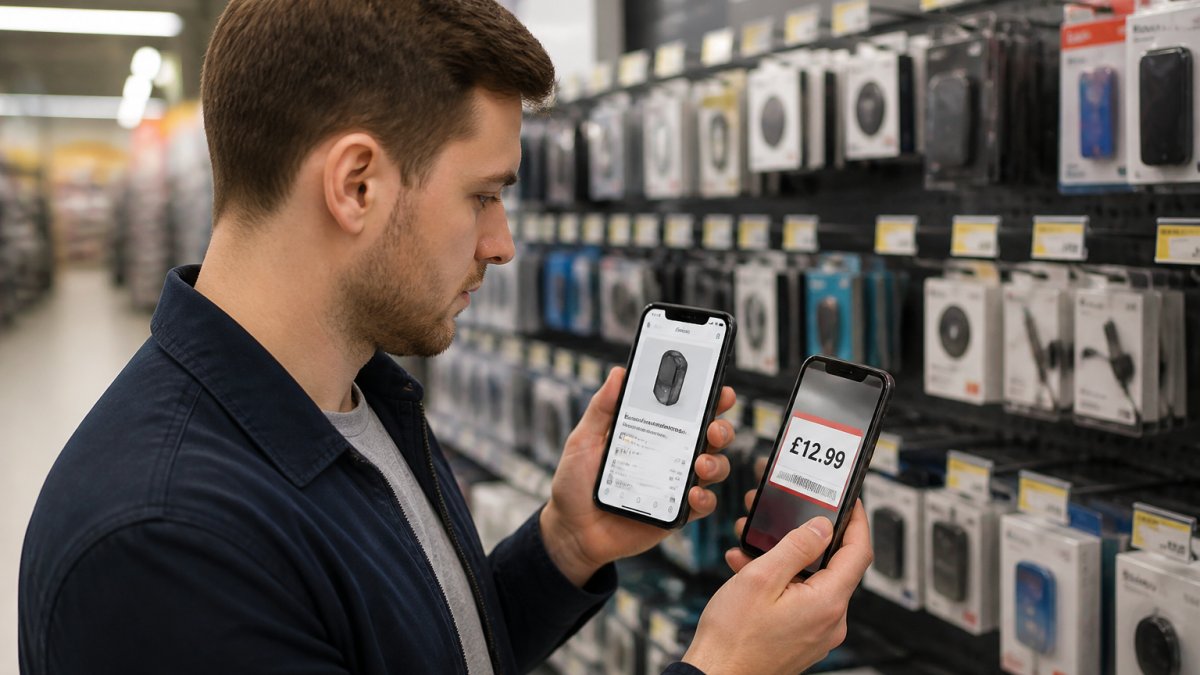
Here is the first thing to understand. Retailers do not publish a genuinely stable price list for accessories. Prices move with promotions, rollbacks and clearance cycles, so any single snapshot ages within weeks.
Retailers lean on everyday low pricing and high-volume rollbacks, or promotional pricing, seasonal markdowns and own-brand assortments.
Target vs Walmart Phone Cases: Price Points and Product Assortment
Phone cases sit at the entry point of tech accessory pricing, and this is where product assortment matters more than the headline price.
For iPhone 15 cases specifically, retailers carry first-party and third-party options, but the shelf mix differs.
| Factor | Target | Walmart |
|---|---|---|
| Own-brand case range | Broader, design-led | Narrower, price-led |
| Entry price point | Mid | Low |
| Premium third-party brands | Yes | Yes |
| In-store stock depth | Strong | Strong |
| Online-only exclusives | Some | Some |
A common mistake is comparing an own-brand case against a third-party case and calling it a price gap. Match the brand tier first, then compare.
Target vs Walmart Phone Chargers: Comparing Cost and Compatibility
Chargers are the accessory category where cost and compatibility pull in opposite directions.
Some retailers' charger aisles lean heavily on multi-packs and budget wall plugs, while others' ranges include more branded fast chargers and bundled cable-and-plug sets.
What most guides miss is the wattage question. A 25W USB-C PD plug will fast-charge a compatible phone, but a generic low-wattage plug will trickle-charge it.
For a straightforward, boxed option, the Samsung Genuine 25W USB C Fast Charging Adaptor Plug at £22.99 supports 25W Super Fast Charging and works with any USB-C PD-supported device, not just Samsung handsets. If you need the cable too, the USB C to USB C 60W RGB Luminous Fast Data Charging Cable at £13.99 handles charging and data transfer in one lead.

Target Price Match Policy: How It Works for Tech Accessories
Price matching is the single most misunderstood part of accessory pricing, because the policy exists to keep your basket in the store rather than to give you the lowest price on the shelf.
Here is the mechanism in plain terms. A price match is a request, made at the point of sale or shortly after, to align the price of an identical item with a lower price advertised by a qualifying competitor. Three conditions decide the outcome:
- Identical item. The product must match on brand, model number, colour and size. A 25W USB-C PD plug from one brand is not identical to a 20W plug from another, even if both sit in the same aisle. For accessories, the model number on the packaging is the test, not the product photo.
- Qualifying competitor. The policy names which retailers count. Large marketplaces, membership clubs, auction sites and third-party sellers on otherwise qualifying platforms are commonly excluded. A marketplace listing is the most frequent reason a request is refused.
- Timing and proof. You need the competitor's current advertised price, in a form the store accepts, usually a live web page or a current printed advert, and the request normally has to fall inside a set window from purchase. A screenshot of a price that has since changed will not qualify.
What the policy typically does not cover is just as important:
- Promotional and clearance prices. A competitor's limited-time rollback, flash sale, coupon code or clearance markdown is usually excluded, because the policy is designed to match everyday advertised prices, not temporary promotions.
- Bundles and multi-buys. A 'buy two, save' offer on cables is not an identical-item price and generally will not be matched against a single-unit purchase.
- Marketplace and membership pricing. Third-party sellers and club-only prices are routinely outside the scheme.
The practical sequence is: confirm the model number on the box, check the competitor's live price on a qualifying retailer's own site, keep the page open on your phone, and make the request before you pay rather than after. If you are buying online, the request usually goes through customer service rather than the checkout, so keep the order confirmation and the competitor link together.
current price match terms and exclusions
Price matching is a pricing strategy, not a courtesy. It exists to stop you walking to the competitor, which is why the exclusions are drawn tightly around promotions and marketplaces.
Walmart Tech Accessory Deals: Rollbacks, Promotions, and Price Trends
Some retailers' discount engines run on rollbacks, which are temporary price cuts on selected items rather than permanent reductions. That distinction matters for price tracking. A rollback can revert, so the price you see this week is not a promise for next week.
USB C to USB C 60W RGB Luminous Fast Data Charging Cable VD-DCF05 →
Watch three signals if you are timing a purchase:
- Rollback labels on the shelf edge and online listing, which flag a temporary cut.
- Seasonal promotions around back-to-school and holiday periods, when accessory bundles get marked down.
- Clearance markdowns on end-of-line colours and older connector types.
Price behavior on accessories is volatile by design. Retailers use these products as traffic drivers because they are cheap to discount and easy to bundle.
Total Purchase Cost: Shipping, Returns, and Hidden Fees
The sticker price is only part of the cost, and this is the gap most comparisons ignore.
Work through it in this order:
- Delivered price. Add the item price to the standard delivery charge. If your basket is below the free-delivery threshold, the charge applies in full, and a £10 cable with £4 delivery is a £14 cable.
- Threshold maths. Free-delivery thresholds are set per order, not per item. If you are £3 short of the threshold, adding a second accessory you will use anyway can be cheaper than paying delivery on the first, but only if the second item is genuinely wanted, not a filler purchase.
- Collection versus delivery. Click-and-collect and in-store pickup usually remove the delivery charge entirely, at the cost of a trip. For a single cable, collection is often the cheapest route to the same product.
- Membership requirements. Some free-delivery and faster-delivery options are tied to a paid membership or a minimum spend tier. If you are not a member, the advertised delivery benefit does not apply to you, and the comparison should use the non-member rate.
- Return postage. Check who pays for return postage on small accessories. A free return is worth more than a small price difference on a product you might send back, and a charged return can wipe out the entire saving.
- Restocking and exclusions. Opened accessories, earphones, screen protectors, opened chargers, are frequently excluded from free returns for hygiene or safety reasons. Check the exclusion list before you buy, not after.
| Cost component | What to check | Why it matters |
|---|---|---|
| Sticker price | Like-for-like model number | Baseline comparison |
| Standard delivery | Free-delivery threshold per order | Can wipe out savings on a single item |
| Collection option | Click-and-collect availability | Usually removes the delivery charge |
| Membership tier | Member vs non-member delivery rate | Advertised benefits may not apply |
| Return postage | Who pays, and whether it is charged | Real cost if the item fails or does not fit |
| Restocking terms | Opened-item exclusions | Affects refund value, not just speed |
A worked example makes the point. Suppose a charger is £2 cheaper at one retailer but sits below that retailer's free-delivery threshold, so standard delivery adds £4. The delivered price is now £2 more expensive than a competitor's, before any return cost. If the item is faulty and return postage is charged, the gap widens again.
The same logic applies to bundles. A multi-pack of cables at a higher sticker price can be the cheaper delivered option if it clears the free-delivery threshold in one order and removes the need for a second delivery later. Run the arithmetic on the basket, not the item.
Quality, Compatibility, and Warranty Trade-Offs
Cheaper accessories fail in predictable ways: connector housings split, cable strain reliefs fray, and plugs run hot under sustained load.
Compatibility is the other trade-off. A universal cable may charge slowly on a device that expects a specific fast-charging standard.
Look for three things on any accessory:
- Stated wattage and standard, such as USB-C PD at a specific wattage.
- Warranty length, which signals how confident the seller is in the build.
- Heat and safety claims, such as heat-resistant construction or overcharge protection.
If you charge multiple devices, a multi-connector lead removes the need to buy three separate cables. The 4 in 1 Multi Fast Charging Cable 60W at £11.99 covers USB-A/C to Lightning and USB-C in a single 1.2m lead, and the 65W version at the same £11.99 adds more headroom for tablets and laptops.

For Apple devices on a budget, the USB A to Lightning Fast Charging Data Cable at £9.99 is a tangle-free 1m option for iPhones, iPads and other Lightning devices.

Conclusion
Comparing retailers on accessories is genuinely harder than it looks, because the shelf price hides shipping, returns and compatibility.
At Metanoia media, we stock a focused range of charging accessories with clear specs and honest prices, including fast-charging plugs, multi-connector cables and durable everyday leads.
Get started with Metanoia media and build a charging kit that lasts longer than the next rollback cycle.
Frequently Asked Questions
Which is cheaper for tech accessories, Target or Walmart?
Some retailers generally list lower entry prices on basic cables and cases, while others often run promotions that bring mid-tier accessories in line. For a like-for-like USB-C cable, the gap can be a few pounds. The cheaper option depends on whether you catch a rollback or a specific offer. Always compare the total cost, including shipping, before deciding.
Does Walmart price-match Target for tech accessories?
Some retailers do not operate a broad price-match guarantee against competitors in the way some shoppers expect. Policies have narrowed over recent years and generally exclude competitor price matching at the register. Other retailers' price match policies are more formal but still have exclusions. Check each retailer's current terms before assuming a match will be honoured, especially on promotional or clearance items.
Are Target or Walmart tech accessories better quality?
Retailers stock a mix of budget and branded accessories. Some lean toward high-volume value lines, while others carry more design-led own-brand ranges. Quality varies by product, not by retailer. Look for stated wattage, cable length, and warranty terms rather than assuming one store is better. A 60W USB-C cable from any retailer can perform well if the specification matches your device.
How can I compare the total cost of tech accessories at Target and Walmart?
Add the item price, any shipping charge, and the cost of a return if the product does not fit. Factor in whether you need a plug separately from a cable, since bundles often cost less than buying each part alone. A £9.99 cable plus a £22.99 plug is a useful benchmark. Compare that combined figure against any bundle deal before choosing.
Which retailer has the better return policy for tech accessories?
Retailers offer standard return windows, typically 30 days for most tech accessories, though opened items may face restrictions. Policies are often seen as straightforward for in-store returns, but can vary by product category. Keep your receipt and original packaging to avoid issues, and check the specific terms for clearance or promotional items.
