

7 Best Screen Protectors for Samsung Galaxy Phones

Last Updated: November 8, 2026
Quick Summary
The best samsung galaxy screen protector depends on your model: the 10D tempered glass at £9.99 suits most S Series owners, while the £19.99 UV glue version is best for curved screens. A Series owners wanting privacy should pick the £9.99 privacy glass.
- Metanoia media stocks four protectors covering the S Series and A Series, priced from £6.99 to £19.99.
- The 2.5D tempered glass at £6.99 does not work with the in-display fingerprint sensor.
- The UV glue protector bonds glass to the full curve using a liquid adhesive cured under UV light.
- Leave the factory-applied film on Z Fold and Z Flip inner displays rather than adding a third-party protector.
- Replace film and hybrid protectors when they yellow or cloud, usually after 6 to 12 months.
Table of Contents
- Quick Comparison: Best Screen Protectors for Samsung Galaxy
- Samsung Galaxy Tempered Glass Screen Protector: What 9H Hardness Actually Means
- 1. Samsung Galaxy S Series Screen Protector Tempered Glass 10D
- 2. Samsung Galaxy S Series UV Glue Screen Protector Tempered Glass
- 3. Samsung Galaxy Screen Protector Tempered Glass 2.5D
- 4. Samsung Galaxy A Series Privacy Screen Protector Glass
- Samsung Galaxy Screen Protector With Fingerprint Sensor Compatibility
- Samsung Galaxy Screen Protector Case Compatibility
- Samsung Galaxy Screen Protector Installation: Bubble-Free in Five Minutes
- What Matters Most When Choosing
- Frequently Asked Questions
Quick Comparison: Best Screen Protectors for Samsung Galaxy
The best screen protector for Samsung Galaxy phones depends on your model and how you use it.
A tempered glass protector is a thin sheet of chemically treated glass that bonds to your display to absorb scratches and impact.
Below, we break down each option we sell, what 9H hardness actually means, and the compatibility details that decide whether a protector works.
| Protector | Price | Best For | Fingerprint Sensor |
|---|---|---|---|
| S Series Tempered Glass 10D | £9.99 | Most S Series owners | Works |
| S Series UV Glue Tempered Glass | £19.99 | Curved screens, strongest bond | Works |
| Galaxy Tempered Glass 2.5D | £6.99 | Budget buyers, flat-screen models | Does not work |
| A Series Privacy Glass | £9.99 | Privacy on the A Series | Works |
Price
Samsung Galaxy Tempered Glass Screen Protector: What 9H Hardness Actually Means
For Samsung Galaxy tempered glass screen protectors, the practical difference shows up at the edges. A rigid sheet on a curved display can lift if the adhesive is weak, which is exactly the problem the UV glue option solves.
Glass, Film, and Hybrid: How the Three Materials Compare
Most buying advice lumps every protector under "tempered glass" and stops there.
| Property | Tempered glass | Film (TPU or PET) | Hybrid (glass-coated film) |
|---|---|---|---|
| Impact resistance | High, spreads force across the sheet | Low to moderate, absorbs knocks but transmits sharp hits | Moderate, better than film, below thick glass |
| Scratch resistance | High (9H surface) | Low, marks from keys and grit | Moderate, coating wears with time |
| Feel | Glass-smooth, closest to the bare display | Slightly rubbery, can drag | Near-glass, small drag on some variants |
| Clarity | Excellent | Good, can haze over months | Very good |
| Flexibility | Rigid, struggles on tight curves | High, conforms to any curve | Moderate, handles gentle curves |
| Edge behaviour on curved screens | Can lift without strong adhesive | Conforms, rarely lifts | Conforms better than glass |
| Fingerprint sensor compatibility | Works if thin enough and no air gap | Usually works | Usually works |
| Typical lifespan | 12-24 months before edge wear | 6-12 months before yellowing or peeling | 9-18 months |
Tempered glass is the default for flat and gently curved Galaxy screens.
Film (usually TPU or PET) is the choice when flexibility matters more than scratch resistance.
Hybrid protectors coat a film base with a glass-like layer.
Watch out: a protector marketed as "9H" may be hybrid or film with a hardness coating rather than true tempered glass.
Matching the Material to Your Galaxy
The right material follows from the screen, not the marketing. Flat-screen Galaxy models, most of the A Series and the flat S Series variants, get the best combination of feel and protection from tempered glass.
If you prioritise scratch resistance and a glass feel, choose tempered glass. If you prioritise a protector that stays put on a curve and you can accept a shorter lifespan, choose film or hybrid.
1. Samsung Galaxy S Series Screen Protector Tempered Glass 10D
Our default recommendation for most S Series owners is the 10D tempered glass at £9.99.
Full touch sensitivity is preserved, and the bubble-free adhesive is designed for easy installation.
It is also case-friendly, so a standard back cover will not push the edges up.
Best for: S Series owners who want reliable protection without spending more than a tenner. Skip if: your phone has a heavily curved display and you have had edge lifting before.
View the Samsung Galaxy S Series Screen Protector Tempered Glass 10D

2. Samsung Galaxy S Series UV Glue Screen Protector Tempered Glass
Curved Galaxy screens are where cheap protectors fail. The UV glue version at £19.99 fixes that with a liquid adhesive that cures under the supplied UV light, bonding the glass to the full curve instead of only the flat centre.
Best for: curved-screen S Series models and anyone who has had edge lifting. Skip if: you want a two-minute install with no curing step.
See the Samsung Galaxy S Series UV Glue Screen Protector Tempered Glass

3. Samsung Galaxy Screen Protector Tempered Glass 2.5D
For everyone else, it does the basics well. It resists fingerprints and keeps full touch sensitivity.
Flat-screen models and anyone who relies on a PIN or face unlock get solid scratch and impact protection for the lowest price on this list.
Best for: budget buyers and flat-screen Galaxy models without an in-display reader. Skip if: you unlock your phone with the fingerprint sensor.
View the Samsung Galaxy Screen Protector Tempered Glass 2.5D

4. Samsung Galaxy A Series Privacy Screen Protector Glass
The tempered glass underneath still delivers full coverage, scratch and impact resistance, and smooth touch response.
It installs with a bubble-free adhesive and fits the A Series front panel flush.
Best for: A Series owners who use their phone in crowded public spaces. Skip if: you want maximum brightness for outdoor viewing.
View the Samsung Galaxy A Series Privacy Screen Protector Glass
Samsung Galaxy Screen Protector With Fingerprint Sensor Compatibility
The 2.5D glass does not work with the in-display sensor.
Samsung Galaxy Screen Protector Case Compatibility
Case compatibility comes down to clearance at the edges. A protector that reaches the very edge of the display can be pushed up by a tight case, which is how most edge lifting starts.
The 10D and UV glue versions are case-friendly. If you are still choosing a cover, our guide on where to buy phone cases online covers what to check before you pair the two.
Foldables: Z Fold and Z Flip Need Different Protection
Foldable Galaxy screens change the rules. Samsung fits a factory-applied film to the inner display, and that film is part of the screen assembly, peeling it off or covering it with a third-party protector can damage the display and may affect your warranty (Screen Protectors for Samsung Galaxy Z Flip and Fold).
The practical guidance for foldables is therefore different from the rest of the range:
- Inner display: leave the manufacturer-installed film in place. Do not add a tempered glass or hybrid protector to the folding screen; it cannot flex at the crease and will lift or crack. If the factory film becomes damaged, have it replaced by an authorised service centre rather than fitting a retail protector.
- Outer (cover) display: this is a conventional flat screen and takes a standard tempered glass protector. Choose a thin glass with full adhesive coverage so the fingerprint sensor, where fitted, keeps working.
- Case fit: foldable cases are engineered around the hinge and the folded profile. A cover-screen protector that extends too far toward the hinge can be pushed up when the phone closes. Check that the protector stops short of the hinge line.
A common pattern among foldable owners is to protect the cover screen with glass and leave the inner display to its factory film. That is the approach least likely to cause damage or warranty complications.
Edge Lifting: Why It Happens and How to Prevent It
The others are adhesive quality, installation dust at the edge, and thermal cycling as the phone heats and cools.
To reduce the risk:
- Fit the protector before the case, so you can seat the edges without the case pushing against them.
- Leave a small margin at the very edge on curved models, a protector that stops just short of the curve is less likely to lift than one that wraps it with weak adhesive.
- Avoid cases with a raised lip that presses directly on the protector edge; a lip that clears the protector is safer.
- If a corner lifts, reseat it promptly. A lifted corner collects dust and the lift spreads.
Watch out: pressing a lifted edge back down without cleaning underneath traps grit against the display, which can scratch the screen over time. Lift the corner, clean with a dust sticker, then reseat.
When to Replace a Protector
Protectors are consumables, not permanent fittings. Replace yours when you see any of the following:
- Yellowing or clouding on film and hybrid protectors, usually after 6-12 months.
- Cracks that run across the viewing area, even if the screen underneath is intact, a cracked sheet no longer spreads impact reliably.
- Persistent edge lifting that returns after reseating, which signals adhesive failure.
- Scratches deep enough to catch a fingernail, which reduce clarity and can harbour grit.
Samsung Galaxy Screen Protector Installation: Bubble-Free in Five Minutes
Bubble-free installation is mostly preparation, not technique. Dust is what causes bubbles, so work in a steamy bathroom where airborne particles settle, wash your hands, and clean the display twice: once with the wipe, once with the microfibre cloth.
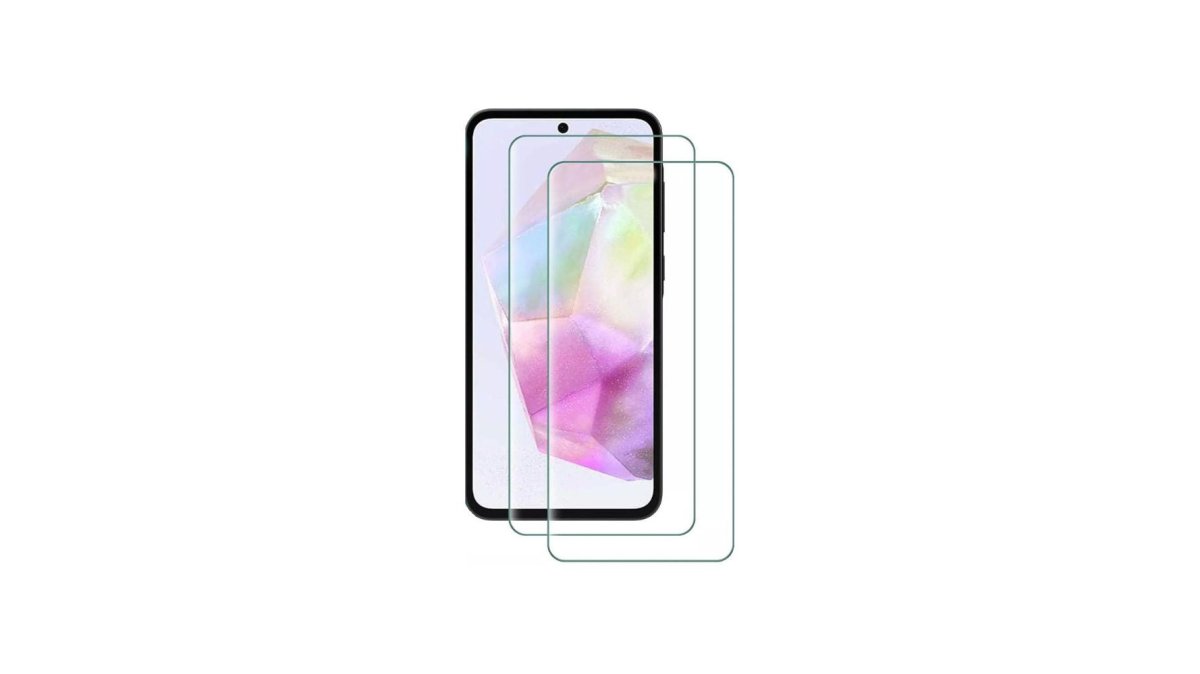
Then follow this sequence:
- Dry-fit the protector without removing the backing to check alignment.
- Peel the backing and lower the glass from one edge, letting it settle.
- Press from the centre outwards with a card wrapped in cloth.
- Lift and re-seat any trapped speck with a dust sticker before pressing down.
- For UV glue, pour the adhesive centrally, seat the glass, and cure under the light as directed.
Watch out: pressing hard on a trapped dust particle can crack the glass, so lift the corner and remove it properly instead.
What Matters Most When Choosing
Buy the protector that matches your phone. Flat-screen and budget buyers can consider the 2.5D, provided they do not rely on the in-display reader.
Choosing protection for a phone you use all day should not take an afternoon of research. Metanoia media stocks all four protectors with clear pricing, from £6.99 to £19.99, alongside the charging and everyday tech accessories that keep your setup running.
Get started with Metanoia media and give your Samsung Galaxy the protection it needs.
Frequently Asked Questions
What is the best type of screen protector for a Samsung Galaxy phone?
Tempered glass suits most people because it resists scratches without dulling touch response. A 10D full-coverage glass like the S Series 10D at £9.99 gives edge-to-edge cover and stays case-friendly. If your Galaxy has curved edges, UV glue glass bonds around the curve and avoids the lifting that flat glass can suffer. Privacy glass on the A Series adds a side-angle filter for commuting. Film is thinner and cheaper but offers less drop protection.
Do Samsung Galaxy screen protectors work with fingerprint sensors?
It depends on the protector. In-display ultrasonic readers on S Series models need glass thin enough for the sensor to read through. The 10D and UV glue protectors are listed with full touch sensitivity. The 2.5D protector is explicitly not compatible with in-display fingerprint sensors, so avoid it on any Galaxy that unlocks through the screen. After fitting, re-register your fingerprint in settings for the most reliable reads.
Are Samsung Galaxy screen protectors compatible with phone cases?
The S Series 10D and UV glue protectors are both listed as case-friendly. The risk comes from tight, rigid cases that grip the sides of the phone. Fit the case a day after the protector and check the corners; if the glass lifts, the case is pressing on the edge rather than the protector being faulty.
How do you apply a screen protector without bubbles?
Clean first, then align. Wipe the display with the microfibre cloth, run a dust removal sticker over the surface, and work in a steamy room so airborne dust settles. Line the protector up with the front camera and earpiece before peeling the backing, then press from the centre outwards to push air to the edges. Small bubbles usually clear within 24 to 48 hours. Larger trapped specks will not, so lift a corner and remove the dust before reseating.
Do screen protectors affect display quality on Samsung Galaxy phones?
The 10D and UV glue protectors are described as crystal-clear with an anti-smudge coating. Privacy glass works differently: it stays clear straight on but darkens the display when viewed from an angle, which is the point. Cheap film can add a slight haze or a rubbery feel under the finger, which is one reason glass is the more popular choice for daily use.
